Simons' cotoneaster
Cotoneaster simonsii
BloomEDU
Identify it today. Know it next time.
Add Simons' cotoneaster to BloomEDU and a short quiz tomorrow will check if the name stuck.
Get BloomEDU — add Simons' cotoneasterFree · iOS · Android
From Instagram
Identity & Classification
Scientific name: Cotoneaster simonsii
Common names: Simons' cotoneaster (also seen as Simon's cotoneaster)
Family: Rosaceae
Genus: Cotoneaster
Taxonomic placement: a member of the cotoneaster group within the rose family (Rosaceae); treated as a distinct species in horticultural and botanical references.
Visual Description
Form and size: A medium, arching shrub often forming a dense, broadly spreading habit; typically reaches several meters in height and width in cultivation. Branches can be gracefully arching, producing a rounded or mounded outline.
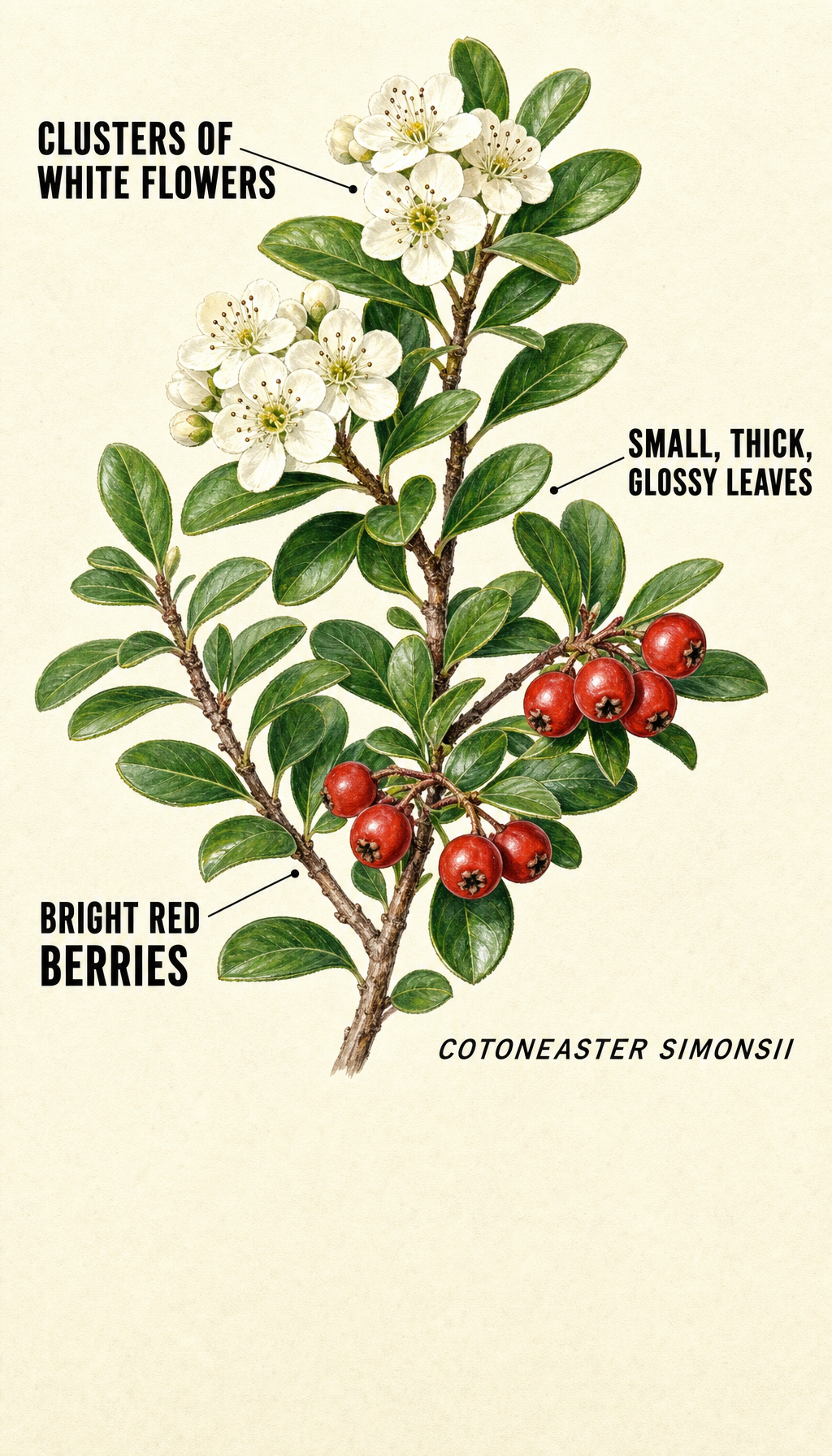
Flowers: Clusters of small, showy flowers produced in terminal or axillary clusters. Flowers typically show 4–6 petals (usually 5), are white to creamy, and bear conspicuous stamens characteristic of Rosaceae. Blooming is often in spring to early summer.
Leaves: Simple, alternate leaves that are glossy and dark green to medium green; shape ranges from elliptic to oblong with entire margins. Leaves may be semi-evergreen to deciduous depending on climate.
Fruits: Small, rounded pome fruits that develop after flowering, typically orange to bright red and often persistent into autumn and winter. Fruits are visually conspicuous and often held in clusters.
Distinctive features: The combination of glossy small leaves, arching twiggy branches, clusters of white flowers, and persistent red/orange pomes makes this species recognizable in cultivation. Dense branching and abundant fruiting are common identifying traits.
Seasonal variation: Leaves may be semi-evergreen in mild climates and deciduous in colder areas. Flowers appear in spring; fruits develop by late summer and often persist into winter, providing seasonal interest.
Habitat & Distribution
Growing conditions: Often planted in gardens, hedges, screens, and urban landscapes. Typically prefers full sun to partial shade and well‑drained soils. Tolerant of a range of soil types and often able to withstand some drought once established.
Typical ecosystems: Common in cultivated and managed settings; can be found in parks, residential plantings, and ornamental windbreaks.
Geographic distribution in the U.S.: Recorded in California (CA), Ohio (OH), Oregon (OR), and Washington (WA) as an ornamental and cultivated plant; occurrence in these states is primarily associated with landscape use rather than wild native populations.
Ecological Role
Pollination: Flowers generally attract bees and other insect pollinators that visit for nectar and pollen.
Wildlife interactions: Fruits are commonly eaten by birds, which can disperse seeds; persistent fruit provides a winter food source for some bird species.
Ecological niche: Functions as an ornamental shrub that also contributes nectar resources during bloom and fruit-based food for avian species later in the season.
Conservation & Interesting Facts
Conservation: No widely recognized conservation concerns for cultivated populations; this species is primarily encountered in horticultural settings.
Interesting facts: Cotoneaster simonsii is appreciated for its winter interest—clusters of brightly colored fruits often persist long after leaf drop. The genus Cotoneaster is notable for its ability to thrive in urban conditions and for providing wildlife value through late-season fruits.