rockspray cotoneaster
Cotoneaster horizontalis
BloomEDU
Identify it today. Know it next time.
Add rockspray cotoneaster to BloomEDU and a short quiz tomorrow will check if the name stuck.
Get BloomEDU — add rockspray cotoneasterFree · iOS · Android
Identity & Classification
Scientific name: Cotoneaster horizontalis
Verified common names: rockspray cotoneaster, wall cotoneaster, herringbone cotoneaster
Family: Rosaceae
Genus: Cotoneaster
Note: Cotoneaster horizontalis is a member of the rose family (Rosaceae) and is one species within the diverse Cotoneaster genus; its distinctive branching habit distinguishes it from many congeners.
Visual Description
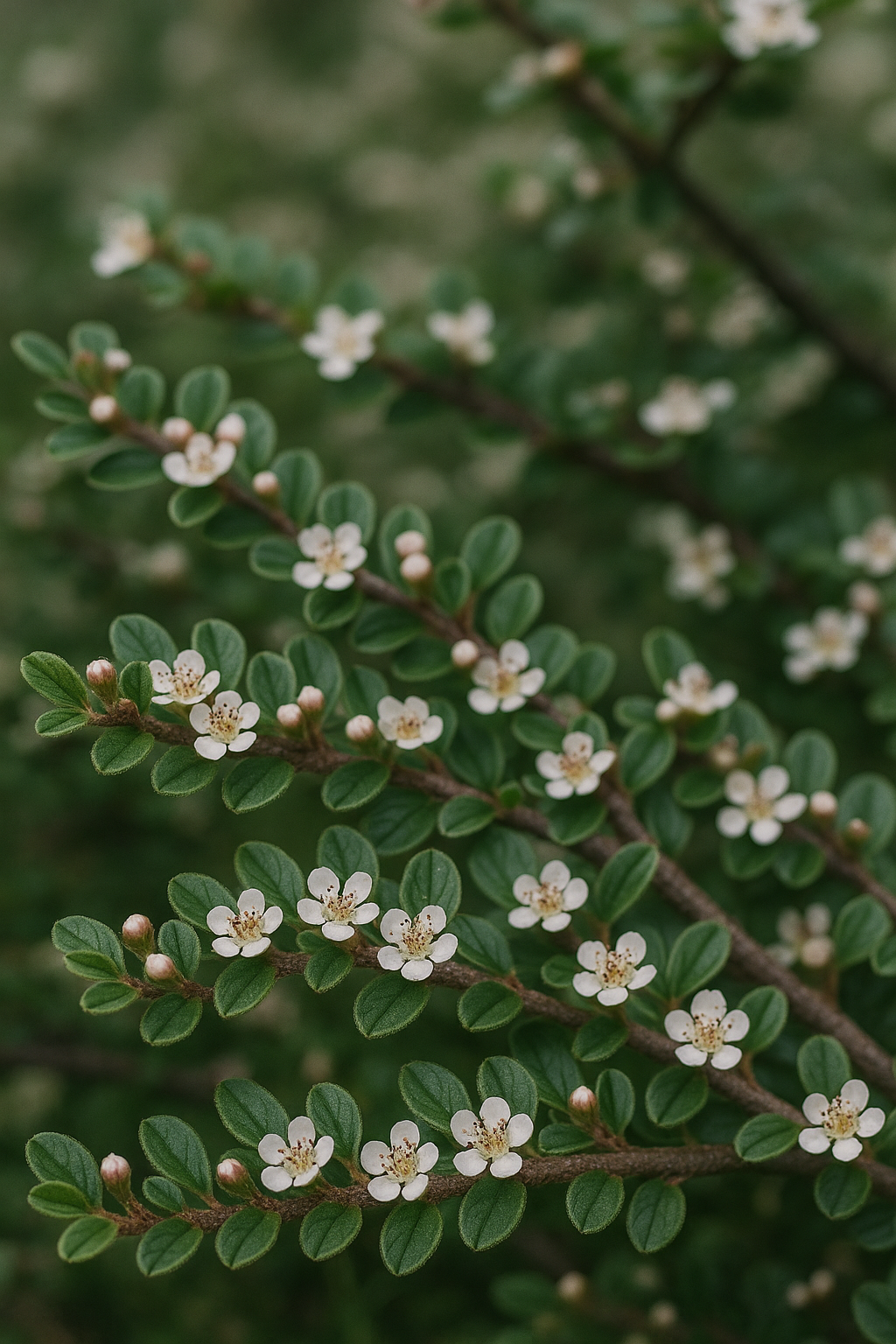
Overall form: A deciduous, low-growing, spreading shrub that typically forms a fanlike, wall-hugging habit with widely spaced, horizontally tiered branches. Plants often remain relatively low in height while spreading broadly in a flattened outline.
Flowers: Small, clustered flowers that are generally white to pale pink, each flower typically bearing 4–6 petals. Flowers appear in spring and are produced in small terminal clusters.
Leaves: Simple, alternate leaves that are small and often glossy; margins can be entire to finely toothed. Leaves are deciduous and may show seasonal color change in autumn.
Fruit: Small, rounded pome fruits that mature to bright red and often persist into autumn and winter, forming conspicuous displays.
Distinctive features: The characteristic herringbone or fanlike branching pattern—flattened, horizontally arranged sprays of twigs with overlapping leaves—is the most reliable field mark. The combination of low, fan-shaped form and persistent red fruits is diagnostic in cultivation and where naturalized.
Seasonal variation: Spring bloom of pale flowers is followed by summer foliage and autumn fruiting; leaves may change color seasonally and fruit can persist into winter.
Habitat & Distribution
Growing conditions and ecosystems: Often planted in gardens, rockeries, on slopes, retaining walls and urban landscapes; it commonly tolerates dry, well-drained sites and can establish on poor or rocky soils. Prefers full sun to partial shade.
Moisture, light, and soil: Typically found in sites with good drainage; drought-tolerant once established and adaptable to a range of soil types.
Geographic distribution: Found in Oregon and Washington (OR, WA), where it is commonly cultivated and may be locally naturalized outside cultivation.
Ecological Role
Pollinators: Spring flowers are visited by bees and other insect pollinators.
Wildlife interactions: The small red fruits are eaten by birds, providing a food resource into autumn and winter; fruiting displays can attract frugivorous species.
Human Uses & Cultural Significance
Modern uses: Widely used as an ornamental for low hedging, groundcover, rock gardens, and erosion control on slopes because of its spreading habit and persistent fruits.
Toxicity: Fruits are generally not regarded as a food for people; caution is often advised regarding ingestion by children or pets, as garden literature recommends avoiding consumption.
Conservation & Interesting Facts
Conservation status: Not generally considered threatened; widely cultivated.
Interesting facts: The plant’s distinctive herringbone branching gives it a highly recognizable, architectural appearance prized in ornamental plantings. Its ability to thrive on poor, sloping sites has made it useful for stabilizing soils in landscaped settings.
From Instagram