long-tubercle beehive cactus
Coryphantha robustispina
BloomEDU
Identify it today. Know it next time.
Add long-tubercle beehive cactus to BloomEDU and a short quiz tomorrow will check if the name stuck.
Get BloomEDU — add long-tubercle beehive cactusFree · iOS · Android
From Instagram
Identity & Classification
Scientific name: Coryphantha robustispina
Common name(s): long-tubercle beehive cactus
Family: Cactaceae
Genus: Coryphantha
Taxonomic note: Coryphantha is a genus closely related to Mammillaria; Coryphantha species are generally distinguished by tubercles that bear a median groove and by flowers produced at the stem apex.
Visual Description
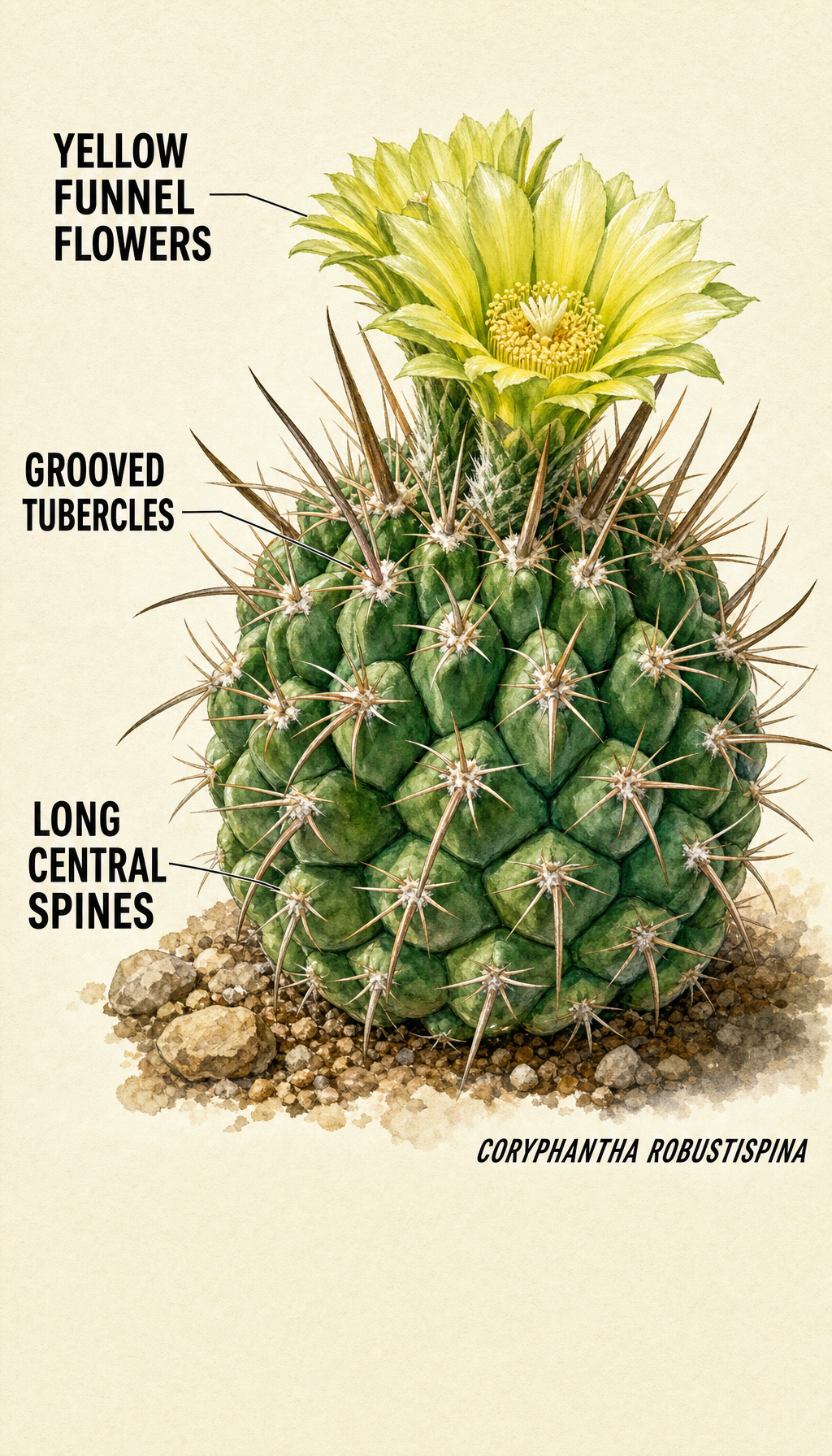
Overall form: A small, globose to short cylindrical cactus that is typically solitary or forming small clumps. Stems are generally compact and appear as individual rounded heads rather than elongated columns.
Size: Plants typically remain relatively low to the ground (single heads or small clusters) and are not tree-like; size can vary with local conditions.
Flowers: Flowers are showy and funnel-shaped, typically yellow to greenish-yellow, opening near the stem apex. Flowers are composed of multiple tepals (often appearing as many layered petals) and are produced in the spring in most populations.
Leaves: Like other cacti, there are no true leaves; photosynthesis occurs in the stem tissue.
Distinctive features: Tubercules are relatively long and pronounced (hence the common name), each bearing an areole with spines; spines are generally robust and may project outward prominently. The apical position of the flowers and the grooved tubercles are useful features for distinguishing Coryphantha from similar genera.
Seasonal variation: Plants typically produce flowers in spring; after flowering they may form small fleshy fruits. Stem color and spine prominence can vary seasonally with growth and water availability.
Habitat & Distribution
General growing conditions: Typically found in arid to semi-arid landscapes on well-drained, rocky or gravelly soils. Often occurs on calcareous or limestone-derived substrates where drainage is good.
Light and moisture: Prefers full sun to partial sun and generally dry conditions; adapted to infrequent rainfall and seasonal drought.
Typical ecosystems: Desert scrub, rocky slopes, mesas, and open grassland/Chihuahuan Desert–type habitats.
Geographic distribution: Native populations are known from the southwestern United States, including Arizona (AZ), New Mexico (NM), and Texas (TX).
Ecological Role
Pollinators: Flowers are adapted to attract insect pollinators, particularly native bees, which are the primary known pollinators of many Coryphantha species.
Wildlife interactions: Fruits provide a potential food resource for small mammals and birds; spines afford protection from many herbivores while shading stem surfaces and reducing water loss.
Ecological niche: A xerophytic, shallow-soil specialist that occupies rockier microsites where competition from larger plants is reduced.
Conservation & Interesting Facts
Unique adaptations: The grooved tubercles and apical flowering are characteristic of Coryphantha and reflect an adaptation to concentrate reproductive structures at the plant apex. Spines and water-storing stem tissue are key xeric adaptations.
Interesting fact: The genus name Coryphantha means “flowering at the top,” referring to the habit of bearing blooms at the stem apex rather than along the sides.