flowering dogwood
Cornus florida
BloomEDU
Identify it today. Know it next time.
Add flowering dogwood to BloomEDU and a short quiz tomorrow will check if the name stuck.
Get BloomEDU — add flowering dogwoodFree · iOS · Android
From Instagram
Identity & Classification
Scientific name: Cornus florida L. Common names: flowering dogwood, Florida dogwood, American dogwood. Family: Cornaceae. Genus: Cornus — the dogwoods, a group of mainly woody shrubs and small trees. Taxonomically this species is a well-established member of Cornus and is distinct from Asian dogwoods.
Visual Description
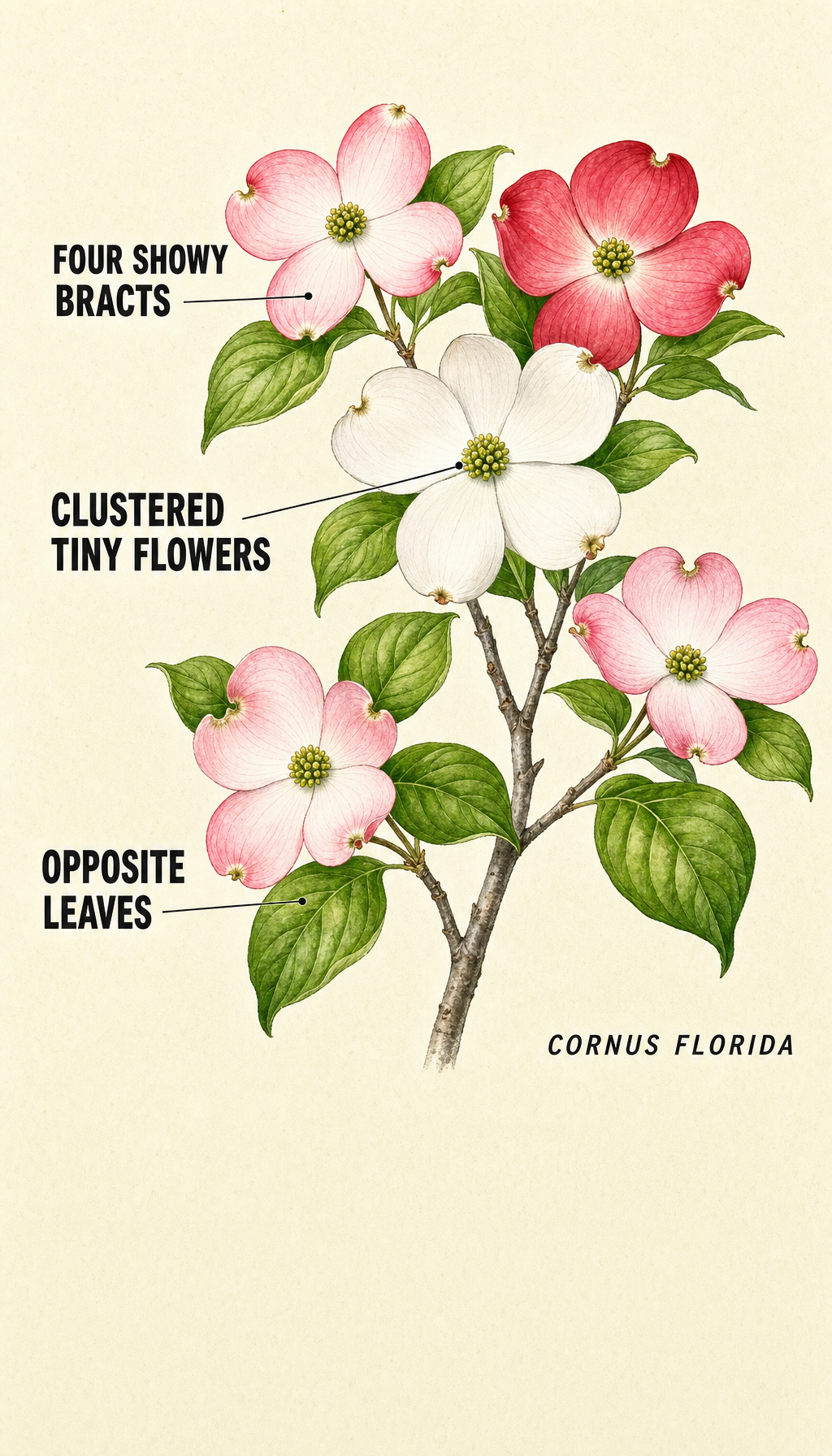
Flowering dogwood is a small, usually multi-stemmed understory tree or large shrub that typically reaches about 10–30 feet (3–9 m) tall. Leaves are opposite, simple, ovate to elliptic with entire margins and characteristic arcuate (curved) veins that sweep toward the tip. The spring “flowers” are clusters of many tiny true flowers surrounded by showy petaloid bracts — usually four large bracts (occasionally three or six) that can be white, pink, or flushed red. Fruits are clusters of bright red drupes that persist into late summer and fall. Bark on mature stems becomes blocky or scaly and may form a distinctive pattern. Seasonally, the species is noted for conspicuous spring bracts, summer foliage, conspicuous fruit in late summer–fall, and often red to purple fall leaf color.
Habitat & Distribution
Flowering dogwood typically occurs as an understory tree in deciduous and mixed woodlands, along forest edges, and in upland sites. It often prefers well-drained, acidic to neutral soils with moderate moisture and commonly grows in partial shade to filtered light, though it can tolerate sunnier exposures in cultivation. The species is native to eastern North America and is recorded from Alabama, Arkansas, Connecticut, Delaware, Florida and 26 additional U.S. states across the eastern and central regions.
Ecological Role
Flowers produce nectar and pollen that are visited by a variety of insects, including bees and other generalist pollinators. The red drupes are eaten and dispersed by many bird species and by some small mammals, making the tree an important seasonal food source and seed dispersal partner in forest ecosystems. As a small understory tree, it contributes to forest structure and provides cover and forage for wildlife.
Conservation & Interesting Facts
Populations have been impacted in parts of its range by dogwood anthracnose (Discula destructiva), a fungal disease that can cause decline and mortality in susceptible trees. A notable botanical fact: the showy white or pink parts commonly called “flowers” are actually bracts (modified leaves) surrounding a cluster of small true flowers. The species remains an emblematic understory tree of eastern North American forests.