bunchberry dogwood
Cornus canadensis
BloomEDU
Identify it today. Know it next time.
Add bunchberry dogwood to BloomEDU and a short quiz tomorrow will check if the name stuck.
Get BloomEDU — add bunchberry dogwoodFree · iOS · Android
From Instagram
Identity & Classification
Cornus canadensis — common names: bunchberry dogwood, Canadian bunchberry, Canadian dwarf cornel, creeping dogwood, crackerberry, quatre-temps.
Kingdom: Plantae
Clade: Angiosperms (flowering plants)
Clade: Eudicots
Order: Cornales
Family: Cornaceae (dogwood family)
Genus: Cornus
Species: C. canadensis
Taxonomic notes: C. canadensis is a low-growing member of the dogwood genus and is often treated as part of the group of dwarf or “bunch” dogwoods (sometimes placed informally in the bunchberry group or subgenus Arctocrania). Different treatments vary in how dwarf dogwoods are circumscribed; I’m sticking to broadly accepted placement in Cornus.
Physical Description
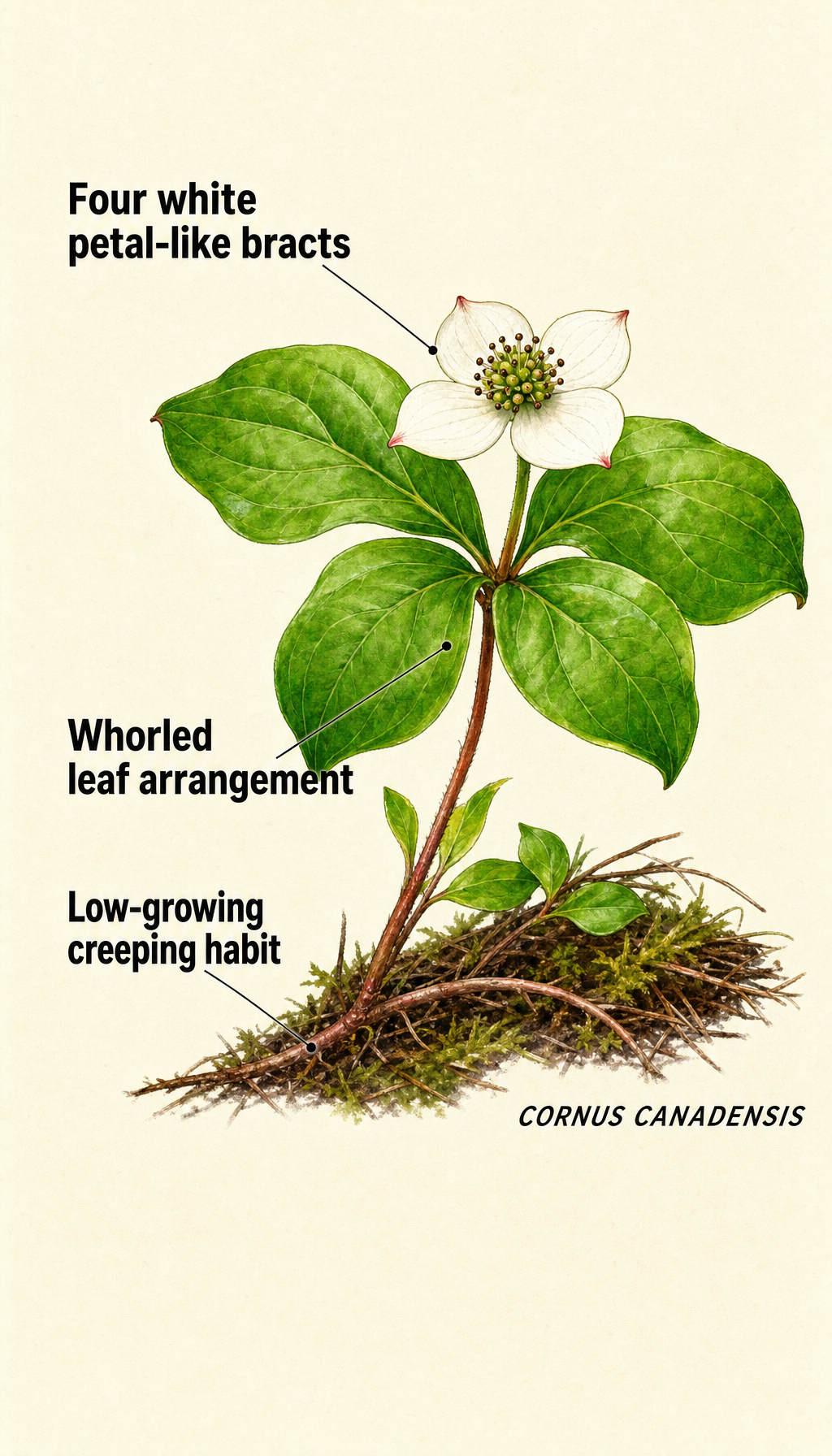
A small, rhizomatous perennial groundcover with a few immediately recognizable traits — like a botanical compact disc of white “flowers” at ground level. Key characteristics:
Size: typically a low herbaceous plant reaching roughly 20 cm (about 8 in) tall.
Growth form: Creeping, rhizomatous stems that form mats or patches on the forest floor.
Leaves: Appears to bear a terminal “whorl” of leaves (commonly 4–6 leaves) at the top of the stem. Leaves are simple, entire (smooth-margined), and elliptic to ovate in outline. Short internodes give the whorled look.
Inflorescence and “flowers”: The true flowers are small and clustered at the center of the head. They are surrounded by several large, showy white (occasionally pink-tinged) bracts that look like petals — typically four prominent bracts, which are what most observers notice first.
Fruit: After flowering the plant produces a tight cluster of red drupes (the “bunch” in bunchberry). The fruits are conspicuous when ripe and persist into late summer.
Reproduction: Spreads by underground rhizomes (vegetative spread) and by seed produced from the drupes.
Habitat & Range
Native distribution: C. canadensis is native to parts of North America and eastern Asia.
Typical habitat: It is a plant of cool, moist, often acidic, humus-rich sites. You’ll most often encounter it in shaded forest understories (especially coniferous and mixed woods), mossy hummocks, bog edges, tundra and in montane or boreal settings.
Growing conditions: Prefers cool temperatures, consistent moisture, good organic matter, and shade to dappled light. It is adapted to northern and montane environments where those conditions prevail. (If you need a detailed political-map range, let me know and I’ll provide a conservative, source-backed outline.)
Ecological Role
Pollination: The species has a dramatic pollination mechanism — the true flowers are equipped with stamens that can release pollen very rapidly onto visiting insects. This rapid staminal movement effectively catapults pollen onto pollinators and is notable among plant movements. Bees (including bumblebees) and other insects visit the flowers and can trigger pollen release.
Fruit and dispersal: The bright red drupes attract birds and small mammals that eat the fruit and disperse seeds.
Groundcover function: By forming mats, C. canadensis helps stabilize soil and contributes to understory structure and microhabitats for invertebrates and small organisms.
Community role: It is a characteristic component of boreal and cool-temperate forest understories, contributing to plant diversity and seasonal food resources for wildlife.
Interesting Facts
Don’t be fooled: the showy white “petals” are actually bracts — modified leaves that frame tiny true flowers in the center. This is similar to larger dogwoods (Cornus spp.), which also use bracts to attract pollinators.
Botanical speedster: the stamens’ sudden movement to fling pollen is one of the fastest plant movements recorded — a neat bit of plant biomechanics you can’t see without slow motion but which makes pollination very efficient.
Carpet-maker: because it spreads by rhizomes, it can form large, attractive carpets on the forest floor — a lovely seasonal tapestry when in bloom and again when fruits are present.
Small but showy: at only ~20 cm tall, this is an example of how striking adaptations (showy bracts, explosive pollen release) can occur even in very low-growing plants. Observation tip: To spot bunchberry in the field, look for a low cluster of whorled leaves topped by a flat “flower” of white bracts — a distinctive silhouette on the shaded forest floor in late spring to early summer.