Conyza subspathulata
Conyza subspathulata
BloomEDU
Identify it today. Know it next time.
Add Conyza subspathulata to BloomEDU and a short quiz tomorrow will check if the name stuck.
Get BloomEDU — add Conyza subspathulataFree · iOS · Android
Identity & Classification
Scientific name: Conyza subspathulata
Common names: no widely established common name documented; members of the genus Conyza are often called horseweeds or fleabanes
Family: Asteraceae
Genus: Conyza — a group of small, herbaceous composites. Taxonomic relationships are within Asteraceae; other Conyza species are commonly treated as closely related horseweeds.
Visual Description
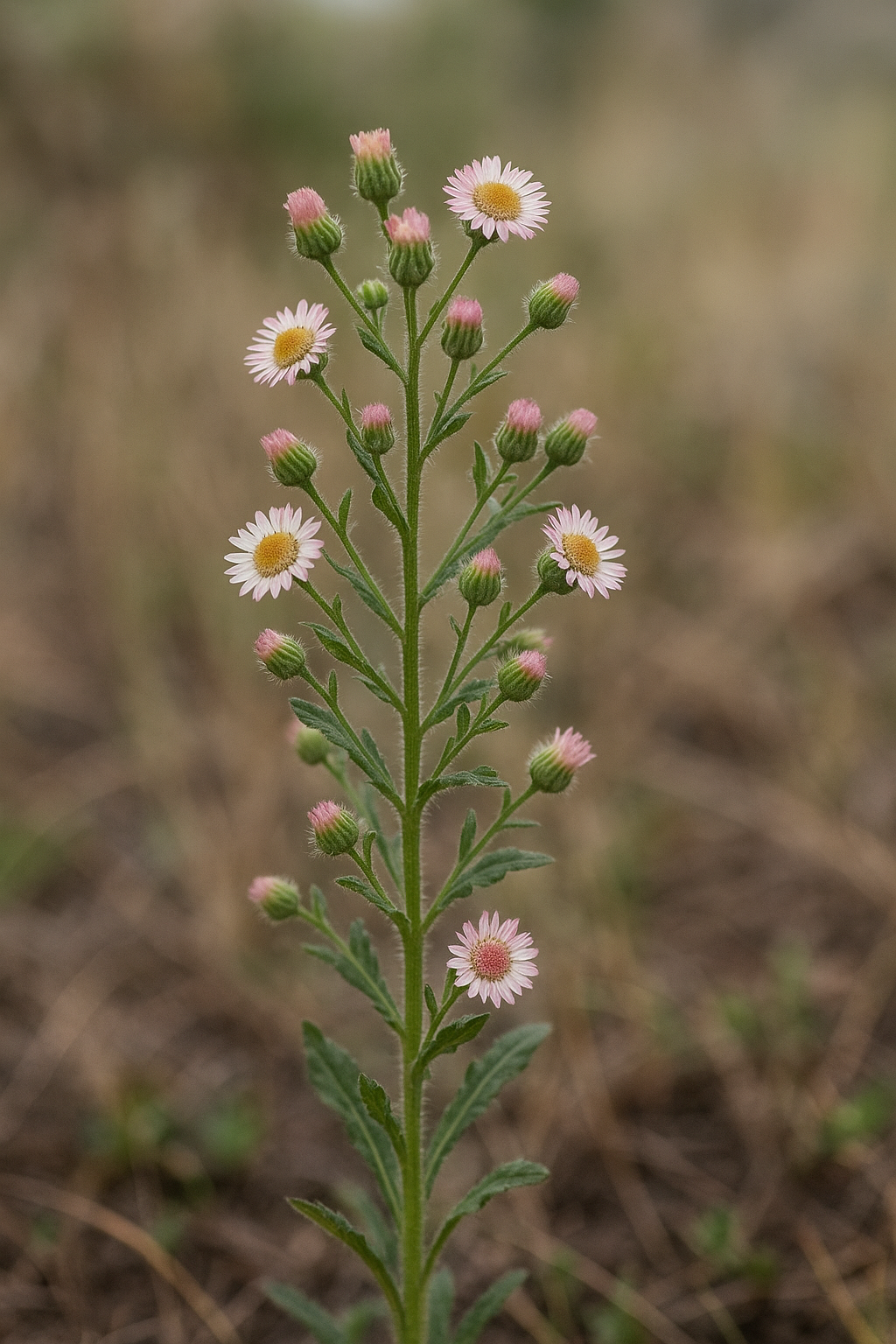
Overall form: Herbaceous, upright and often branching; individuals typically appear as slender, herbaceous plants forming an open, airy habit. Plants in this genus can be annual or short-lived perennial in habit.
Flowers: Inflorescences composed of many small composite heads arranged in loose panicles or branched arrays. Each head is made primarily of numerous tiny tubular disc florets; conspicuous ray florets are often absent or reduced. Flower color in Conyza species is generally pale (white, cream or slightly pink-tinged) but can vary among species.
Leaves: Leaves are typically alternate and simple, often narrow to lance-shaped, and may be somewhat hairy to the touch. Basal and stem leaves can differ, with lower leaves sometimes larger and becoming smaller upward on the stem.
Distinctive features: Very small, numerous flower heads in a branched inflorescence and a pappus of fine hairs on each achene (seed) for wind dispersal are characteristic. Overall appearance is a fine-textured, weedy-looking composite with numerous tiny heads.
Seasonal variation: Flowering may occur in warmer months, often into late summer and fall in suitable climates; foliage and flowering intensity can vary with moisture and light availability.
Habitat & Distribution
General growing conditions: Often found in open, disturbed, or ruderal sites where sunlight is abundant. Typically tolerates a range of soils but is most common on well-drained, drier to mesic substrates.
Moisture, light, soil: Prefers full sun to partial sun and soils that range from sandy to loamy; can commonly occur in dry to moderately moist situations.
Geographic distribution: Documented from Florida. Local abundance and exact range within Florida can vary by habitat and site conditions.
Ecological Role
Pollinators and dispersal: Small insect visitors such as bees and flies commonly visit tiny composite flowers of Conyza species; seeds are adapted for wind dispersal via a fine pappus of hairs.
Wildlife interactions: May provide nectar and pollen resources for generalist pollinators; seeds are small and primarily wind-dispersed rather than a major wildlife food source.
Ecological niche: Often a colonizer of open and disturbed habitats, contributing to early successional plant communities and soil stabilization.
Human Uses & Cultural Significance
No well-documented, species-specific traditional or modern uses are established in widely available botanical literature for Conyza subspathulata.
Conservation & Interesting Facts
Conservation status for Conyza subspathulata is not widely documented in major conservation listings. Notable traits of the genus include production of many small, wind-dispersed seeds (pappus-equipped achenes) that facilitate rapid colonization of open sites, and flower heads comprised largely of tiny disc florets rather than showy rays. These adaptations help Conyza species persist in a variety of disturbed and open habitats.
From Instagram