Etoniah rosemary
Conradina etonia
BloomEDU
Identify it today. Know it next time.
Add Etoniah rosemary to BloomEDU and a short quiz tomorrow will check if the name stuck.
Get BloomEDU — add Etoniah rosemaryFree · iOS · Android
**Identity & Classification**
Scientific name: Conradina etonia
Common name: Etoniah rosemary
Family: Lamiaceae (mint family)
Genus: Conradina
Conradina etonia is a member of the mint family and belongs to the small, aromatic shrub genus Conradina. It is not the same species or genus as culinary rosemary (Salvia/Salvia rosmarinus) despite a similar scent and common-name association.
**Visual Description**
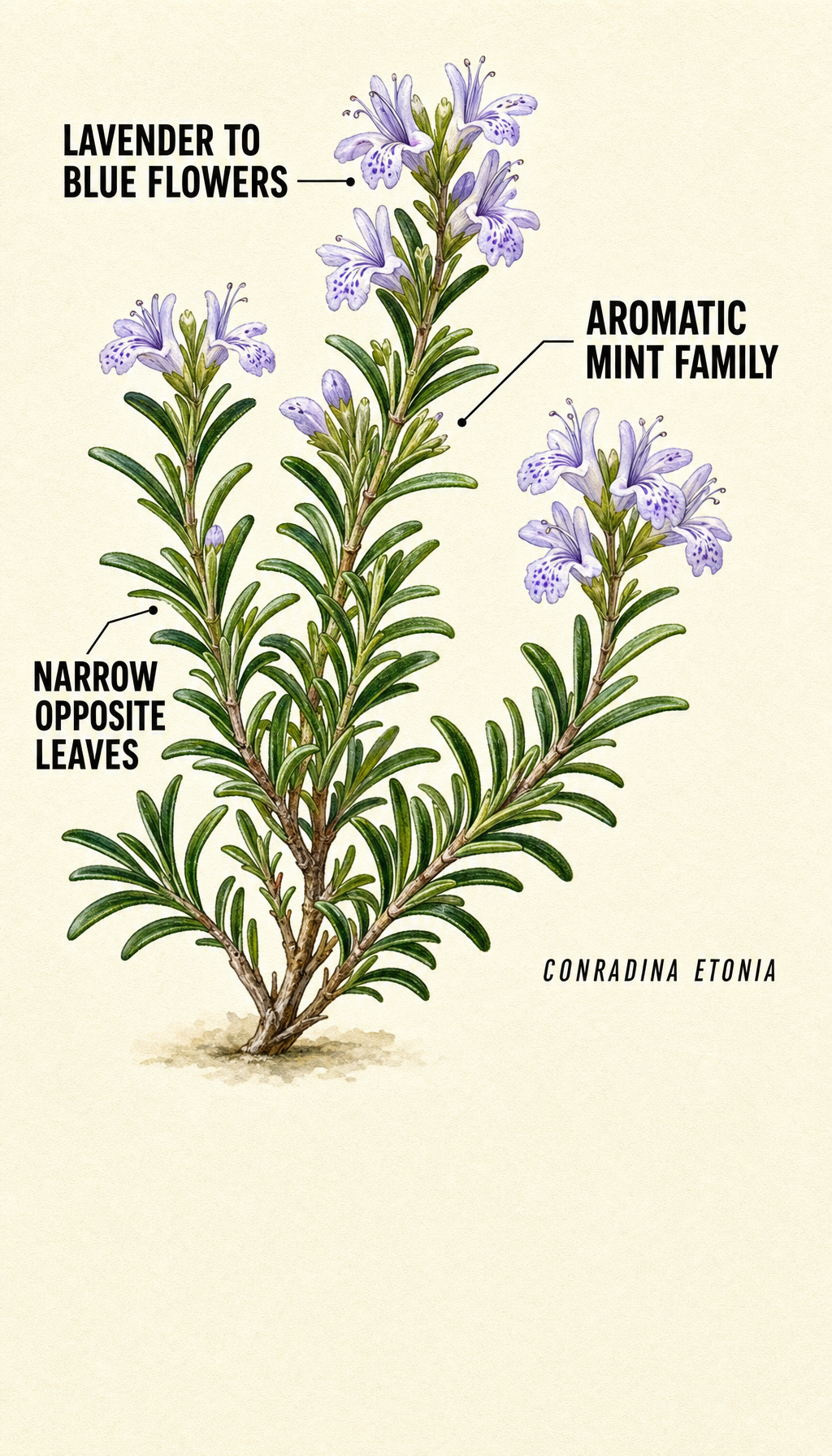
Etoniah rosemary is a small, woody subshrub that typically forms a compact, many-branched mound of gray-green foliage. Plants are generally low-growing and twiggy, often appearing as a rounded shrub in native stands. Leaves are opposite (a characteristic of Lamiaceae), narrow and linear to lanceolate in shape, often with a somewhat revolute (rolled) margin and a resinous or hairy surface that gives a slightly grayish or silvery cast. The foliage is aromatic when crushed.
Flowers are produced in the axils or at branch tips and have the characteristic bilabiate (two-lipped) corolla of the mint family: a fused tubular corolla with an upper lip and a lower, generally three-lobed lip. Flower color is typically in the pale range — often white to pale lavender or blue‑lavender — sometimes with darker markings or spotting on the lower lip that can act as nectar guides. Stamens are typically four, included within the corolla tube. Flowering often shows seasonal peaks but can vary with local climate and conditions.
Distinctive identifying features include the combination of narrow, aromatic, gray-green leaves; a twiggy, low woody habit; and small, pale bilabiate flowers with darker throat markings.
**Habitat & Distribution**
Conradina etonia is native to Florida and has a restricted geographic distribution within that state. It is typically found in xeric, well-drained sandy sites such as scrub, sandhill, or similar dry, open habitats. Plants commonly occur in full sun or open, sunny conditions and are adapted to nutrient-poor, sandy soils. The species is often associated with ecosystems shaped by periodic disturbance.
**Ecological Role**
Flowers are adapted for insect pollination and are often visited by native bees and other insect pollinators seeking nectar. The aromatic foliage and dense growth habit provide shelter and possibly seasonal forage for small insects and invertebrates typical of scrub communities. As a native component of dry, open habitats, it contributes to local plant diversity and pollinator resources.
**Human Uses & Cultural Significance**
The common name reflects the aromatic, rosemary‑like scent of the foliage; however, it is not the same as culinary rosemary and is not widely documented as a culinary herb. No widely documented traditional or commercial uses are well established in the botanical literature.
**Conservation & Interesting Facts**
Conradina etonia has a restricted range within Florida and is associated with specialized, often fragmented habitats. Many species of Florida scrub and sandhill flora are sensitive to habitat alteration and fire-suppression, so species with narrow ranges are typically of conservation interest. An interesting feature of the genus Conradina is its resinous, drought-tolerant foliage, an adaptation to sunny, dry, sandy environments that helps reduce water loss and deter herbivory.
From Instagram