Virginia springbeauty
Claytonia virginica
BloomEDU
Identify it today. Know it next time.
Add Virginia springbeauty to BloomEDU and a short quiz tomorrow will check if the name stuck.
Get BloomEDU — add Virginia springbeautyFree · iOS · Android
Identity & Classification
Scientific name: Claytonia virginica L.
Common names: Virginia springbeauty, spring beauty, eastern springbeauty
Family: Montiaceae (historically placed in Portulacaceae)
Genus: Claytonia
Taxonomic placement in Montiaceae reflects recent treatments; Claytonia is closely allied with other temperate spring‑flowering genera in this family.
Visual Description
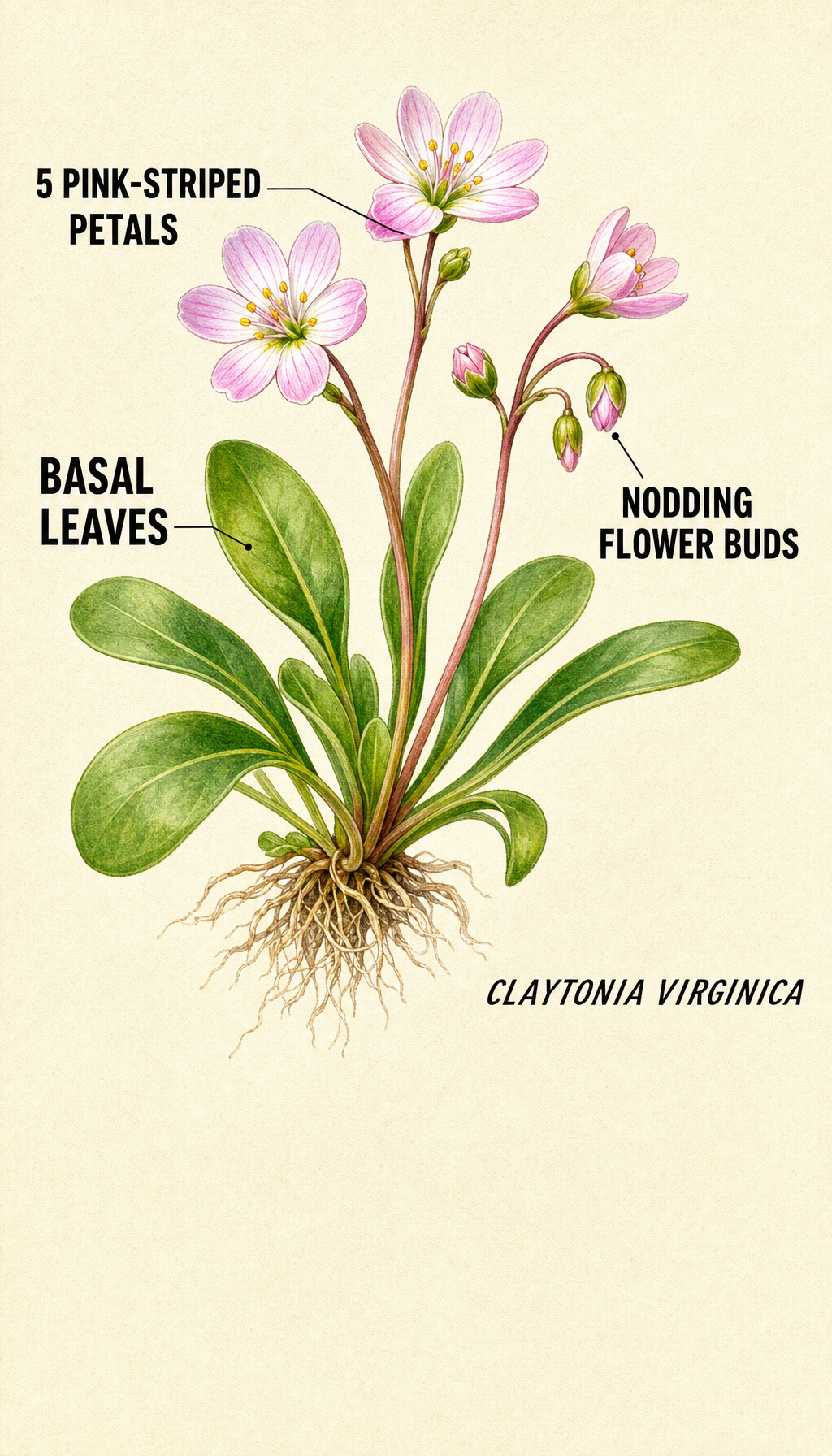
Claytonia virginica is a low, herbaceous perennial spring ephemeral that typically emerges from a small tuberous root and forms loose clumps. Plants are generally short-lived aboveground in spring before senescing as the canopy develops. Flowers are borne singly or in small clusters on slender stems and are typically showy in pale pink to white tones with distinct darker pink to rose veins; the corolla is usually five‑petaled (occasionally four or six). Stamens often have yellow anthers that contrast with the petal veins. Leaves are typically two basal, opposite, linear to lanceolate succulent leaves, sometimes accompanied by a single paired or alternate stem leaf. Distinctive features include the paired basal leaves, tuberous rootstock, and delicately veined pale flowers that open on sunny days. Seasonal variation is pronounced: vegetative and flowering growth occurs in early spring, with aboveground parts often withering after canopy closure.
Habitat & Distribution
Virginia springbeauty is typically found in deciduous woodlands, rich moist forests, floodplain terraces, shaded slopes, and sometimes in meadows or older lawns. It commonly favors humus‑rich, well‑drained to seasonally moist soils and generally grows in part shade to full shade beneath leaf‑bearing trees. Geographically it occurs across much of the eastern and central United States — reported from at least 32 states including AL, AR, CT, DE, GA and many others — and is often most abundant in intact forest understory habitats.
Ecological Role
Springbeauty functions as a classic spring ephemeral, timing growth and reproduction to the brief period of light before tree canopy leaf‑out. Flowers offer nectar and pollen to early‑season pollinators and are commonly visited by small bees and other insect pollinators. By completing its life cycle early, Claytonia virginica occupies a temporal niche that supports spring pollinator communities and contributes to early understory floral diversity.
Human Uses & Cultural Significance
Historically, small tuberous roots of springbeauty have been reported as edible and were used as food by some indigenous peoples and early settlers; such use is described in ethnobotanical literature with qualifying reports. No widespread toxicity is documented in standard botanical references.
Conservation & Interesting Facts
Claytonia virginica is generally widespread and common through much of its range, though local populations can be affected by loss of mature deciduous forest and changing spring hydrology. Notable adaptations include a tuberous rootstock for energy storage and a phenology synchronized to spring light availability; its delicately veined petals act as visual nectar guides for early pollinators.
From Instagram