Suisun thistle
Cirsium hydrophilum
BloomEDU
Identify it today. Know it next time.
Add Suisun thistle to BloomEDU and a short quiz tomorrow will check if the name stuck.
Get BloomEDU — add Suisun thistleFree · iOS · Android
Identity & Classification
Scientific name: Cirsium hydrophilum
Common name: Suisun thistle
Family: Asteraceae
Genus: Cirsium (thistles). Cirsium hydrophilum is a member of the thistle group in the aster family and is taxonomically placed among the cardueoid thistles.
Visual Description
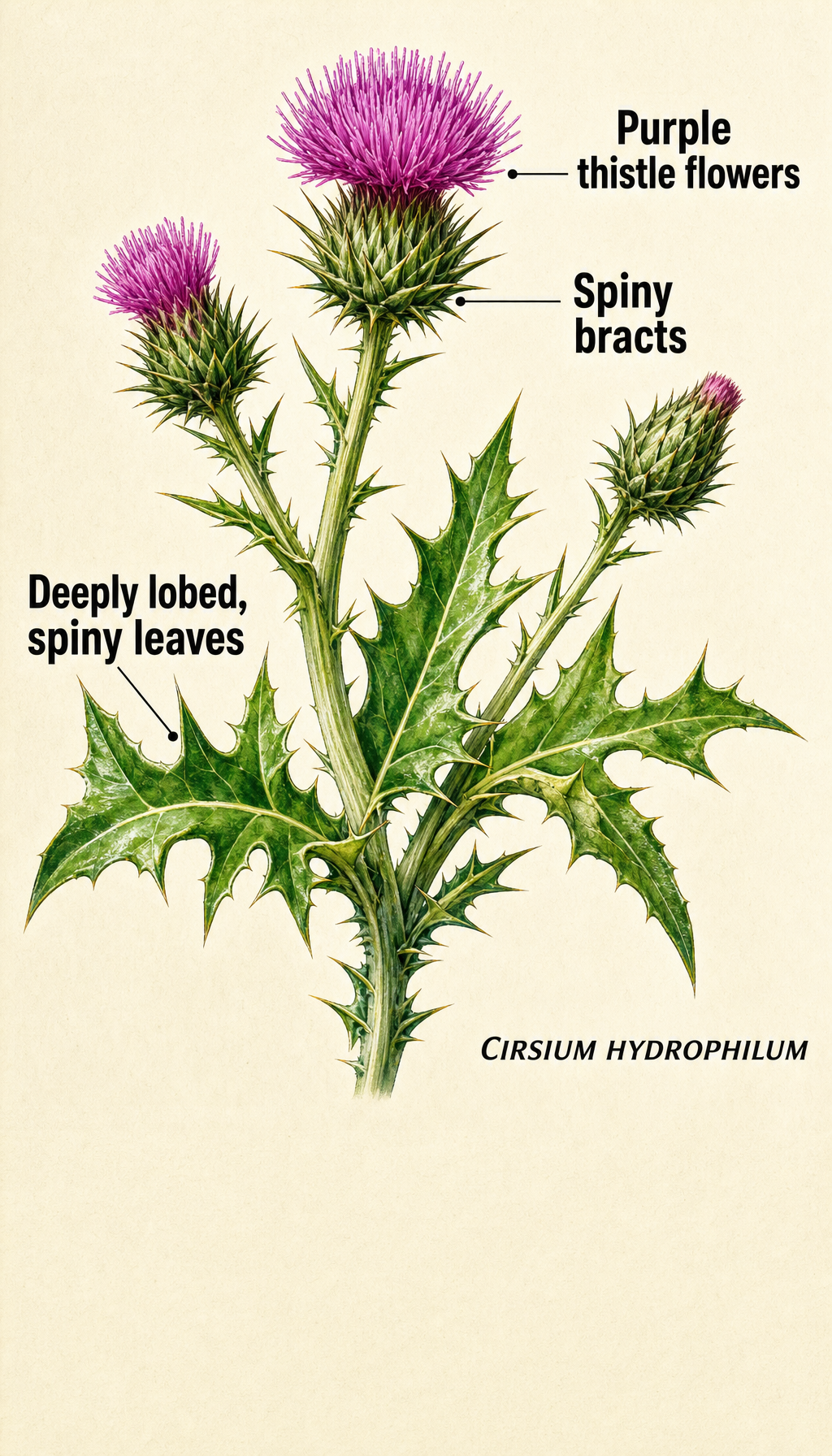
Cirsium hydrophilum is an herbaceous thistle that typically forms a basal rosette of spiny lobed leaves and sends up one or more erect flowering stems. Plants often reach heights from near-ground rosettes to stems of roughly human-knee to chest height, depending on site conditions. Flower heads are classic thistle capitula composed of tubular disc florets (ray florets are absent); florets are typically pink to purple and form globose to ovoid heads subtended by a spiny involucre of bracts. Leaves are pinnately lobed with stiff spines along the margins and often a woolly or cobwebby underside; stem leaves may clasp or alternate along the flowering stem. Distinctive identifying features include the combination of spiny, lobed foliage, the woolly leaf undersides, and showy purple-pink thistle heads set on spiny bracts. Seasonal appearance varies with moisture availability: plants commonly produce a basal rosette in cool, wet seasons and show conspicuous flowering heads during the local growing season.
Habitat & Distribution
Suisun thistle is associated with wet habitats and is often found in marshy, seasonally wet, or brackish-edge sites. It typically favors open, sunny locations in wet meadows, marsh margins, and other low-lying wetlands where soils remain moist for part of the year. Light conditions are generally full sun to partial sun; soils are often heavy, seasonally saturated, and may be slightly brackish in coastal or estuarine settings. Geographic distribution is limited to California, where the species is most commonly associated with the Suisun Bay/Suisun Marsh region and nearby northern California wetlands.
Ecological Role
Flower heads produce nectar and pollen that attract a variety of insect pollinators, especially bees and other short-tongued visitors that can access tubular disc florets; butterflies and other insects may also visit the blooms. Mature seed heads have a plumose pappus that aids wind dispersal of seeds, and seeds or down may be used incidentally by small birds or other wildlife. As a wetland-associated thistle, Cirsium hydrophilum contributes to local floral diversity and provides structural habitat in marsh-edge plant communities.
Human Uses & Cultural Significance
No widely documented modern or traditional uses specific to Suisun thistle are presented here; thistles in general have been used variably by people, but specific cultural uses should be referenced from primary ethnobotanical sources when available.
Conservation & Interesting Facts
Populations of Cirsium hydrophilum are limited by its dependence on wetland habitats, which have been reduced or altered by development and hydrological change; as a result, the species is of conservation concern in its restricted range. The species epithet hydrophilum literally means “water-loving,” reflecting its affinity for wet sites. Thistles in the genus Cirsium carry a feathery pappus on each seed that promotes wind dispersal, a notable adaptation for colonizing open wetland patches.
From Instagram