chicory
Cichorium intybus
BloomEDU
Identify it today. Know it next time.
Add chicory to BloomEDU and a short quiz tomorrow will check if the name stuck.
Get BloomEDU — add chicoryFree · iOS · Android
From Instagram
Identity & Classification
Cichorium intybus — commonly called chicory (among other vernacular names) — is a member of the sunflower/daisy family, Asteraceae (also known as Compositae). It belongs to the tribe Cichorieae, a group characterized by flower heads made entirely of ligulate (strap-shaped) florets.
Kingdom: Plantae
Clade: Angiosperms → Eudicots → Asterids
Order: Asterales
Family: Asteraceae (Compositae)
Genus: Cichorium
Species: Cichorium intybus
Common names: chicory, common chicory, wild endive, blue sailors, blue dandelion (these vary by region). Note: several cultivated forms of Cichorium intybus have been selected for different uses (leaf vegetables, forced roots), and they are usually treated as variants or cultivar groups of this species.
Physical Description
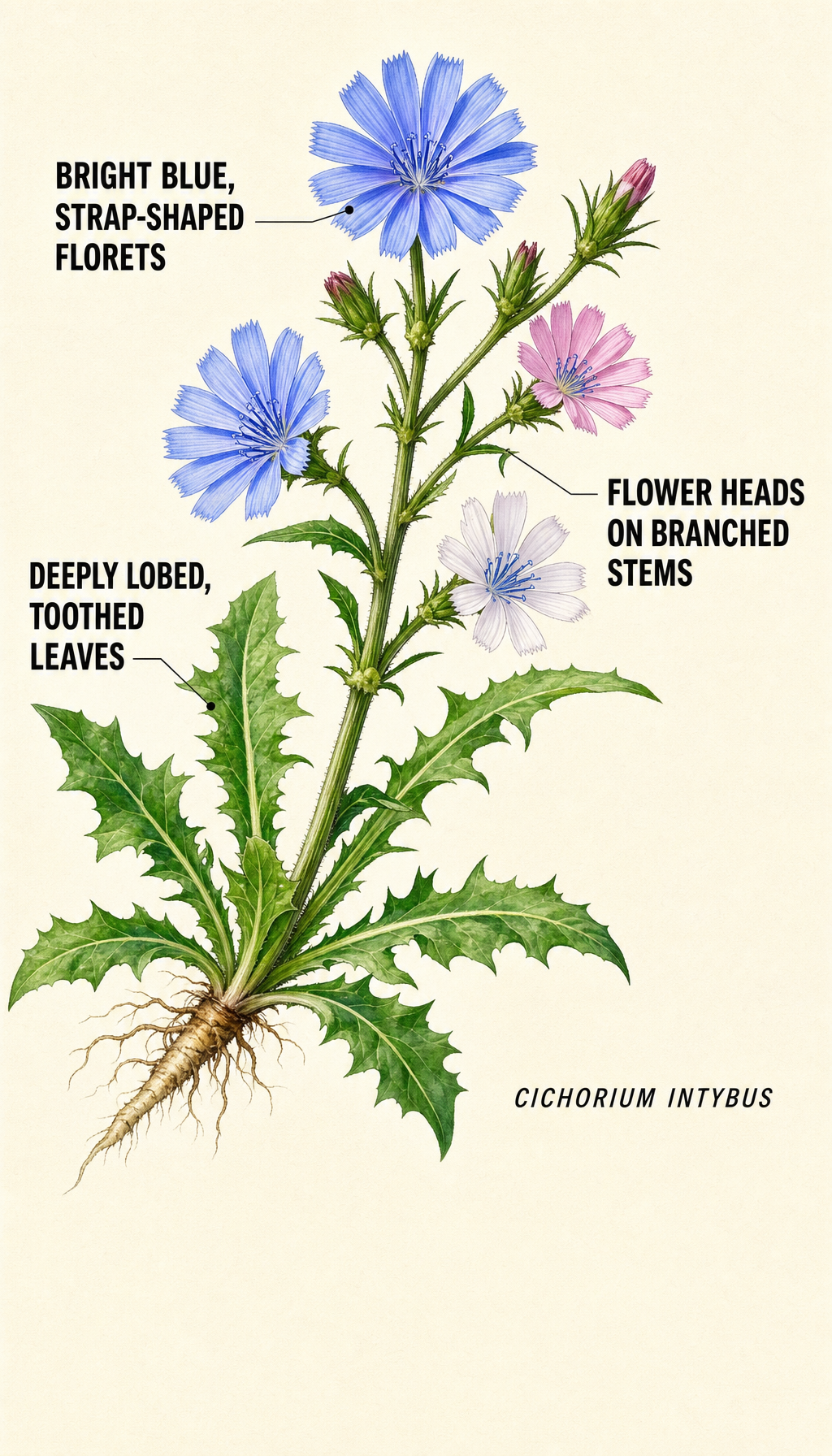
A robust, typically herbaceous perennial with a deep taproot and showy blue flowers — chicory is both unmistakable and mildly rebellious (it loves roadsides). Key characteristics
Habit: Perennial herb, often forming a basal rosette of leaves with one or more erect, branching stems. Plants commonly reach roughly 0.3–1.5 m tall, depending on conditions and cultivar.
Root: A stout, often long taproot (fleshy), which can be branched; the root is the part traditionally used for roasting/processing. Roots contain significant stores of the carbohydrate inulin.
Leaves: Basal rosette leaves are typically oblong to lanceolate and toothed; stem leaves are alternate, narrower, and may clasp the stem. Leaves can be quite variable in shape among wild and cultivated forms.
Flowers: Flower heads (capitula) consist solely of ligulate (strap-shaped) florets — no central disc florets. The typical wild form bears bright cornflower-blue ray florets, usually about 2–4 cm across; white or pink-flushed forms are occasionally seen. Individual florets are roughly tongue-shaped and give the flower a fringed look.
Flowering behavior: Flower heads open in the daytime (often early morning) and individual florets are short-lived; flowering along a stem is often sequential.
Fruit: Achenes (dry, one-seeded fruits) often with a pappus (bristles) that can aid in wind dispersal — typical of many Asteraceae.
Habitat & Range
Chicory is a sun-loving, disturbance-tolerant plant that often shows up where soils are open and drainage is at least moderate.
Native and introduced: Chicory is native to Europe and parts of western Asia and is widely naturalized in many temperate regions worldwide (including North America and Australia).
Typical habitats: Roadsides, fields, disturbed ground, grasslands, pasture margins, and other open, sunny sites.
Soil and light: Prefers full sun to light shade and well-drained soils; shows tolerance for relatively poor soils and can persist under dry conditions because of its deep taproot.
Seasonal notes: As a perennial, populations persist year to year from the rootstock; flowering commonly occurs in summer into early autumn in temperate climates.
Ecological Role
Chicory plays a useful part in sunny, open ecosystems and human-modified landscapes.
Pollinator resource: The conspicuous blue flower heads provide nectar and pollen that attract a variety of daytime pollinators, including bees and other insects (chicory is often visited by generalist pollinators).
Seed dispersal: Produces achenes with pappus structures that can be dispersed by wind, allowing colonization of open or disturbed sites.
Vegetation dynamics: As a hardy perennial with a deep root, chicory can persist in low-fertility soils and often appears in roadside and field communities; it can be a “pioneer” on disturbed ground.
Specific species interactions: Chicory is commonly visited by many insects, but specific tightly coevolved relationships (specialist herbivores or obligate mutualists) are not broadly documented for the species as a whole.
Interesting Facts
A few botanical tidbits to make your plant-geek heart flutter:
Blue in a sea of yellow: Chicory’s cornflower-blue flowers are relatively unusual among Asteraceae, making roadside drifts especially striking.
One-day wonders: Individual florets are short-lived; the showy display comes from many florets opening in sequence along the stem.
Deep-storage specialist: The fleshy taproot stores inulin, a reserve carbohydrate that humans now harvest for food-industry uses — chicory is essentially a natural inulin factory.
From weed to plate: What many people think of as a common roadside weed also has cultivated relatives that appear on restaurant menus (radicchio, forced chicory/witloof), illustrating the species’ versatility under selection.
Tough and tidy dispersal: The species produces achenes with pappus bristles, a typical wind-dispersal strategy for its family, which helps it recolonize open ground after disturbance.