spider plant
Chlorophytum comosum
BloomEDU
Identify it today. Know it next time.
BloomEDU can suggest a name from a plant photo, and later ask if you still know it.
Get BloomEDUiOS · Android
From Instagram
Do you know spider plant?
Three questions from BloomEDU's question library for this plant. Pick an answer, or open Show the answer, to see why.
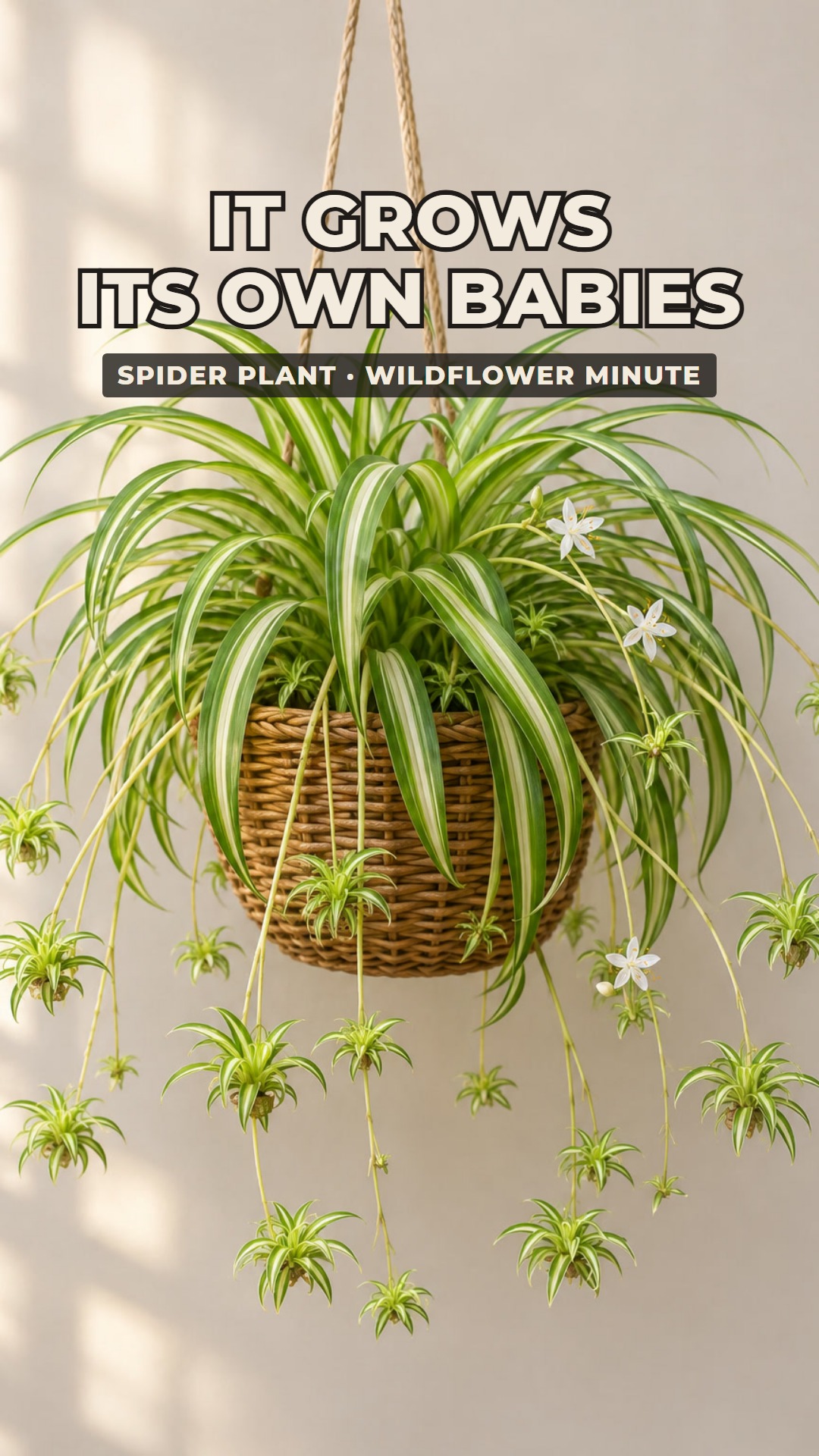
What distinctive feature helps identify a spider plant in a hanging basket or on a porch?
Show the answer
Answer: Arching stems that produce many small plantlets (baby plants) along them
Why: Its long, arching stems often carry a whole row of dangling baby plants, making a mature spider plant look as though it is sending out little green offspring from the basket.
The flowers of spider plant are usually described as which of the following?
Show the answer
Answer: Small, star-shaped, white flowers with six similar tepals
Why: The flowers are tiny white stars, with six similar tepals rather than a showy, differentiated set of petals and sepals.
Spider plant typically grows best in which of these conditions?
Show the answer
Answer: Bright, indirect light with evenly moist, well-drained soil and moderate humidity
Why: Spider plants are happiest in bright, indirect light with soil kept evenly moist but not waterlogged; moderate humidity helps them stay vigorous.
Identity & Classification
Scientific name: Chlorophytum comosum. Verified common names: spider plant, airplane plant, ribbon plant. Family: Asparagaceae (the genus has historically been placed in Liliaceae in older classifications). Genus: Chlorophytum. Taxonomic relationships: a monocotyledonous perennial related to other garden and houseplant genera within the asparagus order.
Visual Description
Overall form and size: A clump-forming perennial with a rosette of long, arching, strap-shaped leaves arising from a central crown. Plants typically form a dense mound and can produce wiry flowering stems that arch outward; individual leaf length and overall plant size can vary by cultivar and growing conditions.
Flowers: Small, star-shaped, white flowers with six tepals (the three petals and three sepals are similar in appearance) produced on slender, arching inflorescences. Flowers are produced in clusters along the stem and often give way to small capsule fruits with seeds.
Leaves: Simple, linear to lanceolate, often glossy; many common cultivars show green-and-white variegation (striped or edged), while some are solid green. Leaves are basal, forming a fountain-like habit.
Distinctive features: Production of stolon-like flowering stems bearing freely produced plantlets (pups) that resemble miniature adult plants—this “spider” appearance of dangling plantlets is a key identifying trait. Variegated cultivars and the hanging habit in cultivation also aid recognition.
Seasonal variation: Flowering and production of plantlets is often seasonal and can be more frequent in warm, favorable conditions; indoor plants may bloom sporadically.
Habitat & Distribution
General growing conditions: Commonly cultivated as a houseplant and in warm gardens; typically prefers bright, indirect light but tolerates lower light levels. Often grown in hanging baskets or containers where arching stems are visible.
Moisture, light, soil: Prefers evenly moist, well-drained soil and moderate humidity; tolerates brief dry periods once established. Performs best in fertile, humus-rich substrates but is adaptable to a range of potting mixes.
Geographic distribution: Native to parts of tropical and southern Africa; in the United States it is commonly cultivated and can be found naturalized or escaping cultivation in warm, humid areas, including Florida and Georgia.
Ecological Role
Pollination and wildlife interactions: Flowers are typically visited by small generalist insects (such as small bees and flies) that can effect pollination. Vegetative propagation via plantlets allows rapid local spread in suitable microhabitats. No major wildlife dependence is documented.
Conservation & Interesting Facts
Conservation status: Not considered threatened as a cultivated species and widely propagated.
Notable facts: The ability to produce rooted plantlets on arching stolons is a well-documented vegetative adaptation that aids rapid propagation and makes the species especially easy to multiply. Spider plants are often mentioned in studies and popular summaries on indoor air quality for their capacity, in controlled experiments, to remove certain volatile organic compounds from enclosed air.