marshland goosefoot
Chenopodium humile
BloomEDU
Identify it today. Know it next time.
Add marshland goosefoot to BloomEDU and a short quiz tomorrow will check if the name stuck.
Get BloomEDU — add marshland goosefootFree · iOS · Android
**Identity & Classification**
Chenopodium humile — common name: Marshland Goosefoot. - Family: Amaranthaceae (placed here by modern APG systems; older treatments separate Chenopodioideae as Chenopodiaceae). - Genus: Chenopodium — the “goosefoots,” a large genus of herbaceous plants. Chenopodium is the namesake genus of the subfamily Chenopodioideae. - Taxonomic notes: Chenopodium is a broadly defined genus with many species that vary in habit and habitat. Specific taxonomic treatments and the limits of some Chenopodium species have changed over time; for Chenopodium humile, authoritative regional floras or monographs should be consulted for the most up-to-date nomenclature and synonyms. **Physical Description**
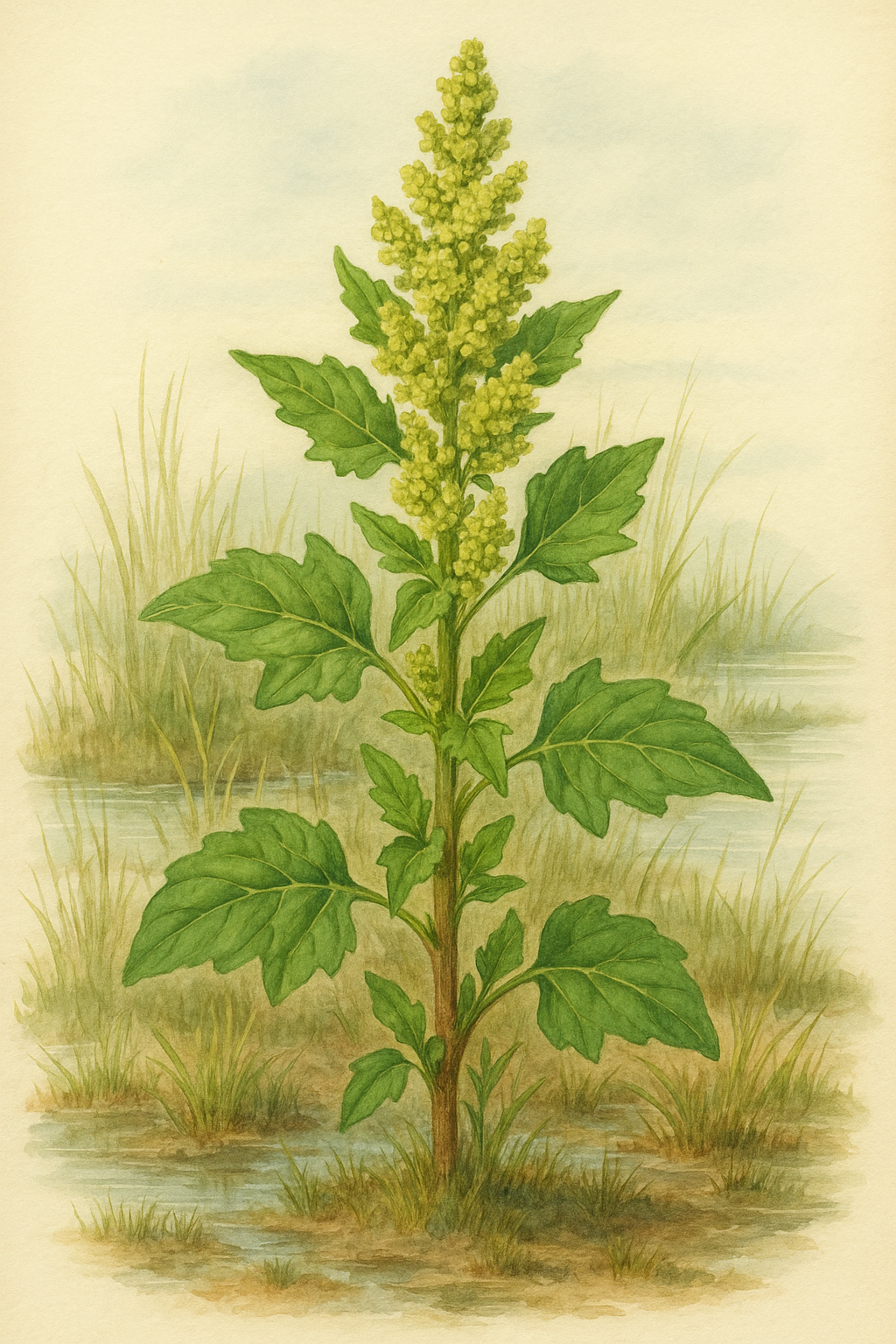
A compact, herbaceous “goosefoot” — exact habit can vary with site conditions. Key characteristics (generalized from typical Chenopodium morphology and reported traits associated with marshland-adapted species):
- Leaves: alternate; often with the characteristic goose-foot (reniform to triangular or rhomboid) outline seen in the genus. Margins may be entire to slightly toothed or lobed depending on the individual and growing conditions. - Surface texture: plants in this group often have a mealy or farinose (powdery) coating on young leaves and stems; C. humile may show this trait to varying degrees. - Stems: usually herbaceous and branching; can be low-growing or somewhat erect depending on substrate and competition. - Inflorescences and flowers: small, inconspicuous greenish to yellow-green flowers arranged in clusters (glomerules) or loose panicle-like clusters. Flowers typically lack showy petals and are composed of a few small tepals (perianth lobes) surrounding the reproductive parts. - Fruits and seeds: small, dry fruits that contain a single seed; seeds in Chenopodium are usually small, lenticular and dark (brown to black) and may have a hard seed coat. Note: precise size ranges (height, leaf dimensions) and the degree of farinose coating for C. humile are variable in the genus and are not universally documented for this species in the sources available here. **Habitat & Range**
- Habitat: The common name “Marshland Goosefoot” suggests an affinity for wet or seasonally wet habitats. Members of the genus occupy a wide variety of habitats worldwide; some species of Chenopodium are adapted to marshy or saline environments. C. humile is associated with wetter ground in at least some accounts, but habitat details can vary regionally. - Geographic distribution: Specific, authoritative global or regional range maps for Chenopodium humile are not supplied here. Chenopodium as a genus occurs across much of the globe, but precise distribution of C. humile should be confirmed from regional floras, herbarium records, or trusted botanical databases for the area of interest. - Soil and microhabitat preferences: may tolerate moist or seasonally wet soils; tolerance for salinity or alkalinity is known in some Chenopodium species but is not definitively documented for C. humile in the sources available here. **Ecological Role**
- Pollination: Chenopodium flowers are typically small and inconspicuous; many species rely on self-pollination or wind pollination, though tiny insects may also visit the flowers. The specific pollination biology of C. humile is not well-documented here. - Food web contributions: In the genus broadly, seeds can be a food source for granivorous birds and small mammals, and foliage may be eaten by insect herbivores. It is plausible that C. humile contributes similarly to local food webs, but direct species-level studies are not cited here. - Ecosystem functions: Goosefoots can be early colonizers of disturbed ground and can influence local plant community dynamics; some species persist in seed banks. Whether C. humile plays these roles locally depends on site conditions and is not universally documented. **Human Uses & Cultural Significance**
- Specific cultural, culinary, or medicinal uses of Chenopodium humile are not well-documented in the sources available for this description. - Cautionary note: several other Chenopodium species are historically important for humans (for example, Chenopodium album as a leafy vegetable in many traditions, and Chenopodium quinoa as a cultivated grain). However, one must not extrapolate those uses to C. humile without clear, species-specific documentation. Do not assume C. humile is edible, medicinal, or toxic without authoritative, local guidance. **Interesting Facts**
- “Goosefoot” name origin: The common name comes from the typical leaf shape in many species that resembles a goose’s foot — a delightful bit of botanical pareidolia. - Low profile, big genus: Chenopodium includes a wide variety of growth forms and ecologies, from garden weeds to important crops (e.g., quinoa). That diversity means a single species like C. humile can’t be assumed to share all the traits of its charismatic cousins. - Mealy coating as an adaptation: The powdery or farinose coating found on many Chenopodium leaves reflects light and can reduce water loss — an elegant adaptation when plants live in exposed or saline environments. C. humile may show some degree of this coating. - Tiny flowers, efficient reproduction: The small, petal-less flowers of Chenopodium are a reminder that showy blooms aren’t necessary for success — many species rely on wind, self-fertilization, or inconspicuous insect visitors to set seed. - Compare C. humile to a closely related, well-documented Chenopodium in form and ecology for field-identification help.
From Instagram