fireweed
Chamerion angustifolium
BloomEDU
Identify it today. Know it next time.
Add fireweed to BloomEDU and a short quiz tomorrow will check if the name stuck.
Get BloomEDU — add fireweedFree · iOS · Android
From Instagram
Identity & Classification
Chamerion angustifolium — commonly called fireweed (also known as rosebay willowherb, great willowherb, willowherb) — is a member of the evening-primrose family, Onagraceae. Taxonomic notes: this species has been placed in the genus Epilobium in older treatments (you will often see the synonym Epilobium angustifolium). Modern treatments commonly use Chamerion angustifolium, but both names appear in the literature.
Physical Description
A tall, showy perennial herb with a few characteristic features that make it hard to miss in summer meadows and burn sites.
Habit: upright, often unbranched or sparingly branched stems arising from an underground creeping rootstock (rhizome), forming colonies.
Height: typically ranges from about 0.5 to 2 m tall (often closer to 1–1.5 m in many stands).
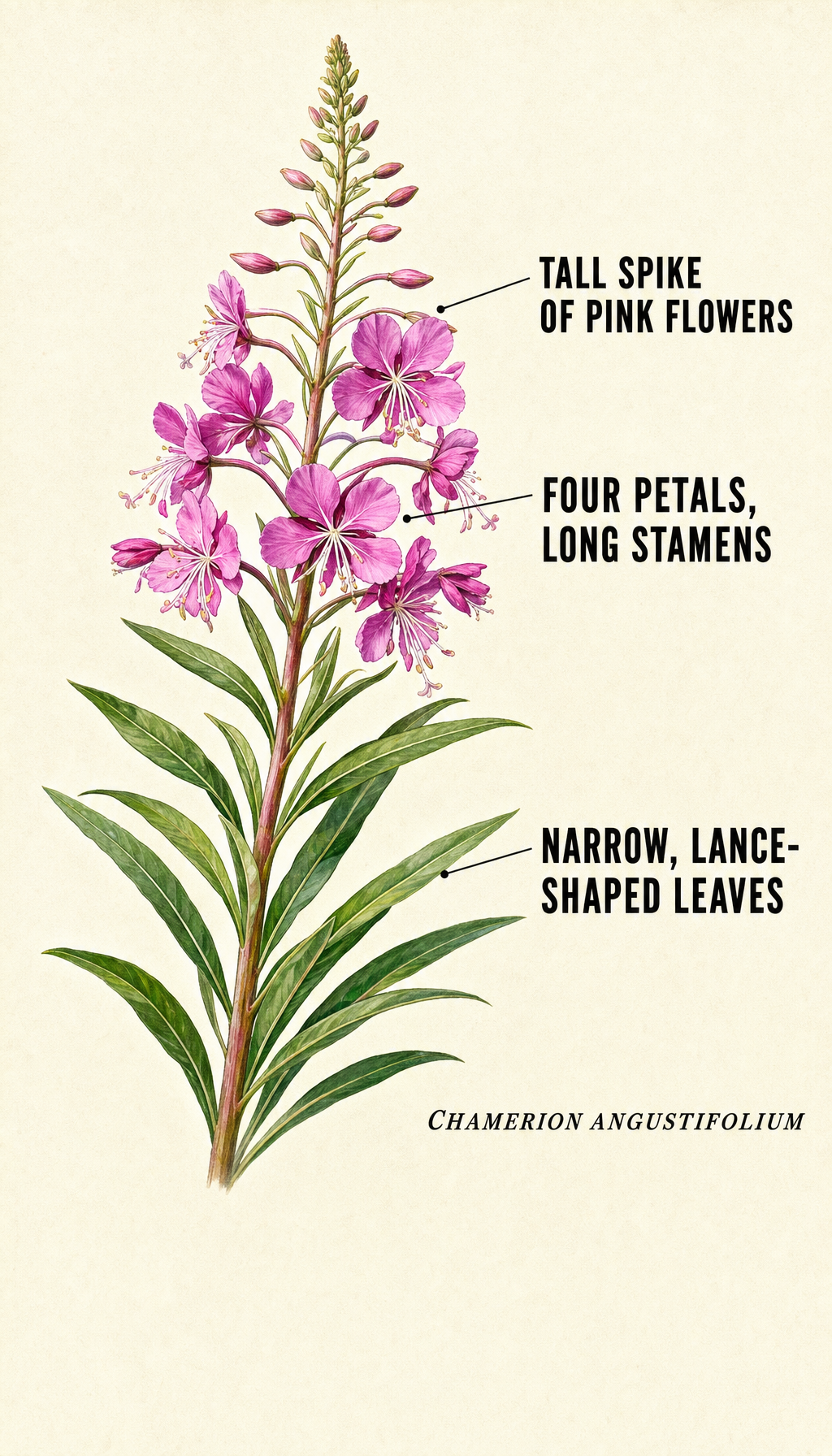
Leaves: lanceolate (long and narrow with a pointed tip), usually arranged alternately in a spiral; leaves have a prominent midrib and are sessile or nearly so (short- or no petiole). Leaf size is variable but often several centimeters long.
Inflorescence and flowers: a terminal raceme (a vertical cluster that elongates as it blooms) of showy flowers. Each flower has four petals (a diagnostic feature for many Onagraceae), typically pink to magenta in color but sometimes paler or white. Petals are often notched at the tip. Individual flowers are roughly on the order of 1–3 cm across (varies by plant).
Fruit and seeds: produces an elongated capsule that splits open at maturity to release many small seeds, each attached to a tuft of silky hairs (coma) that aids wind dispersal.
Roots: spreads by rhizomes as well as by seed, allowing rapid colonization of open ground.
Habitat & Range
Distribution: fireweed has a broadly circumboreal/temperate presence — it occurs across much of the cooler and temperate parts of the Northern Hemisphere (North America, Europe, and Asia) and is also naturalized in other regions.
Typical habitats: favors open, sunny sites and is famously one of the earliest and most conspicuous colonizers of disturbed ground — think recently burned forests, roadcuts, clearings, meadows, and stream banks.
Soil and moisture: usually found on well-drained to moist soils and tolerates a range of soil types, including acidic soils. It often increases in abundance after disturbance because its life history traits (rhizomes, abundant wind-dispersed seed) suit quick establishment.
Ecological Role
Pollinators: fireweed is a prolific nectar and pollen source and attracts a wide variety of pollinators, including bees and butterflies (and in regions where they overlap, hummingbirds may visit as well). Its abundant, nectar-rich flowers make it an important forage plant for pollinating insects.
Successional species: because it readily colonizes disturbed sites, fireweed is often a prominent early to mid-successional species. It helps stabilize soils and create vegetative cover that facilitates later-arriving species.
Seed dispersal: seeds are adapted for wind dispersal via silky hairs (coma), allowing long-distance colonization of open habitats.
Other relationships: it supports a community of insects (pollinators and herbivores) and can form dense stands that alter light and soil conditions locally. Specific host–insect relationships exist, but they vary geographically and are not comprehensively summarized here.
Interesting Facts
The common name “fireweed” reflects the species’ affinity for freshly disturbed or burned ground — it often bursts into flower in post-fire landscapes and is a classic early colonizer.
Showy, sequential flowering: the raceme blooms from the bottom upward, so a single stalk can display a succession of open flowers and developing seed capsules over weeks.
Windborne babies: each seed rides a silky parachute (coma) — a neat and effective wind-dispersal gadget that helps the plant reach new open spaces.
Taxonomic split: the species has been moved between Epilobium and Chamerion in various taxonomic treatments; you’ll see both names in field guides and older literature.
Landscape architect’s paradox: gardeners and restorationists sometimes prize fireweed for rapid cover and pollinator value, while others consider it a vigorous colonizer that can dominate disturbed sites if left unchecked.