roundleaf sensitive pea
Chamaecrista rotundifolia
BloomEDU
Identify it today. Know it next time.
Add roundleaf sensitive pea to BloomEDU and a short quiz tomorrow will check if the name stuck.
Get BloomEDU — add roundleaf sensitive peaFree · iOS · Android
Identity & Classification
Scientific name: Chamaecrista rotundifolia
Verified common name: roundleaf sensitive pea
Family: Fabaceae
Genus: Chamaecrista
Note: Chamaecrista is a genus of legumes once included in a broader Cassia grouping; this species is placed in Chamaecrista by modern treatments.
Visual Description
Overall form: A low-growing perennial herb or subshrub that often produces sprawling to erect stems and can form loose mats or clumps. Plants are typically low in stature and may branch from a basal region.
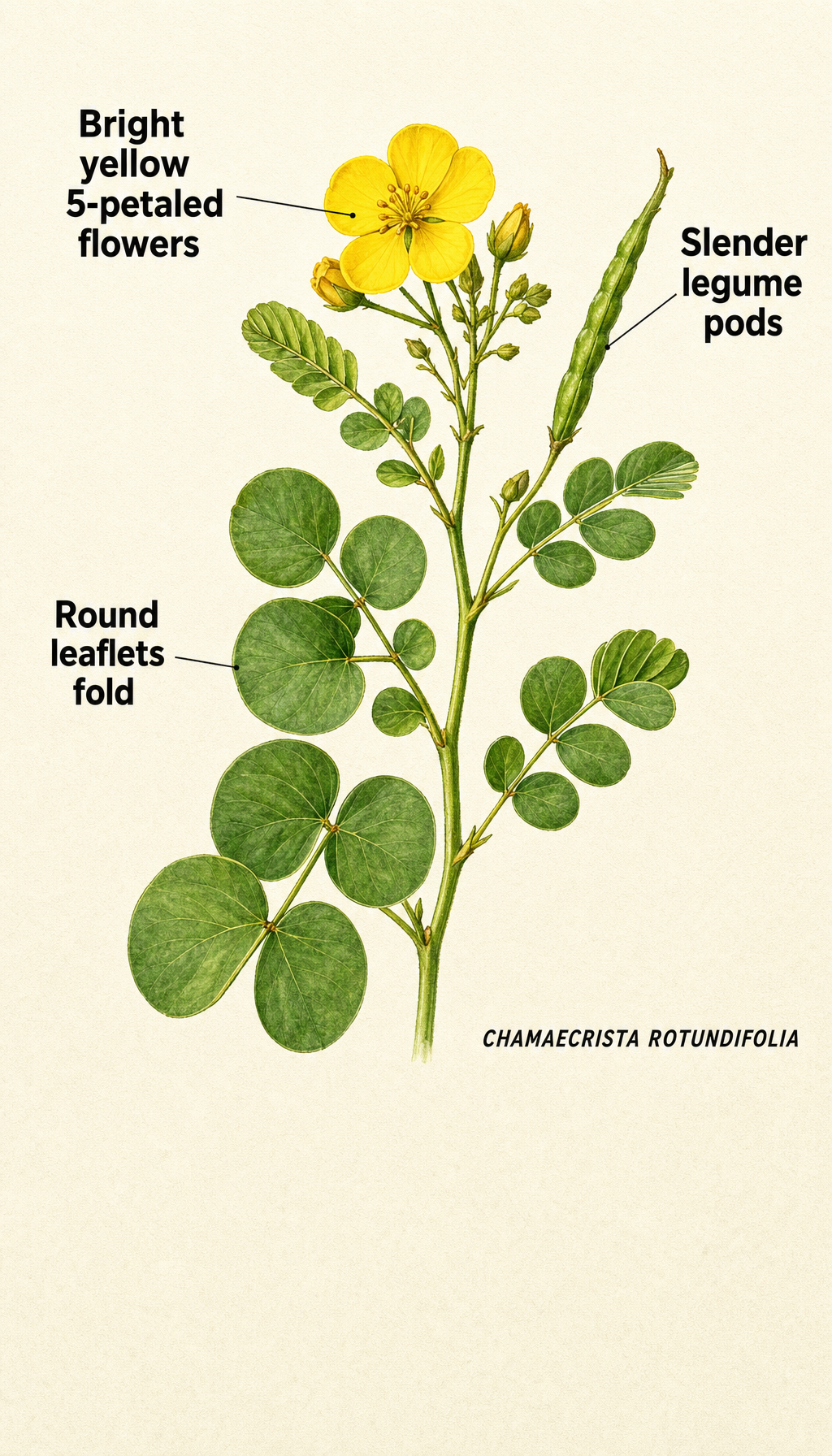
Flowers: Bright yellow, pea-type flowers with a typical petal count in the 4–6 range (most often five), showing the characteristic banner, wings and keel of legumes. Flowers are usually borne singly or in small clusters along stems.
Leaves: Alternate, pinnately compound leaves with several pairs of small, broadly rounded to nearly circular leaflets—hence the common name “roundleaf.” Leaflets have smooth to slightly crenate margins and a noticeable rounded outline.
Distinctive features: Rounded leaflet shape distinguishes this species from many other Chamaecrista with narrower leaflets. Bright yellow pea-like flowers and the leguminous pods that develop after flowering are additional field marks. Leaflets may show folding or movement (nyctinastic or touch-responsive) in some plants or conditions, which contributes to the “sensitive” vernacular.
Seasonal variation: Flowering and vegetative vigor generally increase in warm seasons; plants may be most conspicuous when in bloom and less so in cooler periods.
Habitat & Distribution
General growing conditions: Typically found in open, sunny sites and tolerant of warm conditions. Often associated with well-drained, sandy or loamy soils and can tolerate relatively dry conditions compared with many meadow species.
Typical ecosystems: Common in disturbed sites, pastures, roadsides and open natural areas where soils are not waterlogged.
Geographic distribution: Recorded in Florida. The species is associated with warm, subtropical to tropical environments and is commonly encountered in warm regions outside this state as well.
Moisture, light, soil: Prefers full sun to partial sun, often found on soils that are well-drained and moderately infertile; frequently tolerant of periodic drought.
Ecological Role
Pollination: Flowers are primarily visited and pollinated by bees, which are attracted to the bright yellow blooms typical of many legumes.
Soil interactions: As a legume, it forms symbiotic associations with nitrogen-fixing bacteria, contributing to soil nitrogen enrichment in its immediate surroundings.
Wildlife interactions: May provide forage value for grazing animals and offer nectar and pollen resources for native pollinators and other insects.
Human Uses & Cultural Significance
Well-documented uses: Often used as a forage, cover crop or soil-improvement species in warm regions because of its palatability to livestock and its ability to enhance soil nitrogen through symbiosis with root bacteria.
Conservation & Interesting Facts
Conservation status: Not listed here; local status may vary by jurisdiction.
Interesting facts: The compact, rounded leaflets are a reliable field trait for quick recognition. The common name “sensitive pea” reflects leaflet movement observed in some plants, a subtle nyctinastic or touch response that is less dramatic than in Mimosa but characteristic enough to inspire the name.
From Instagram