Santa Catalina centaury
Centaurium nudicaule
BloomEDU
Identify it today. Know it next time.
Add Santa Catalina centaury to BloomEDU and a short quiz tomorrow will check if the name stuck.
Get BloomEDU — add Santa Catalina centauryFree · iOS · Android
Identity & Classification
Scientific name: Centaurium nudicaule
Common names: Santa Catalina centaury
Family: Gentianaceae
Genus: Centaurium
Centaurium nudicaule is a member of the gentian family (Gentianaceae). Its placement in Centaurium aligns it with other small, herbaceous centauries known for showy, often pinkish corollas.
Visual Description
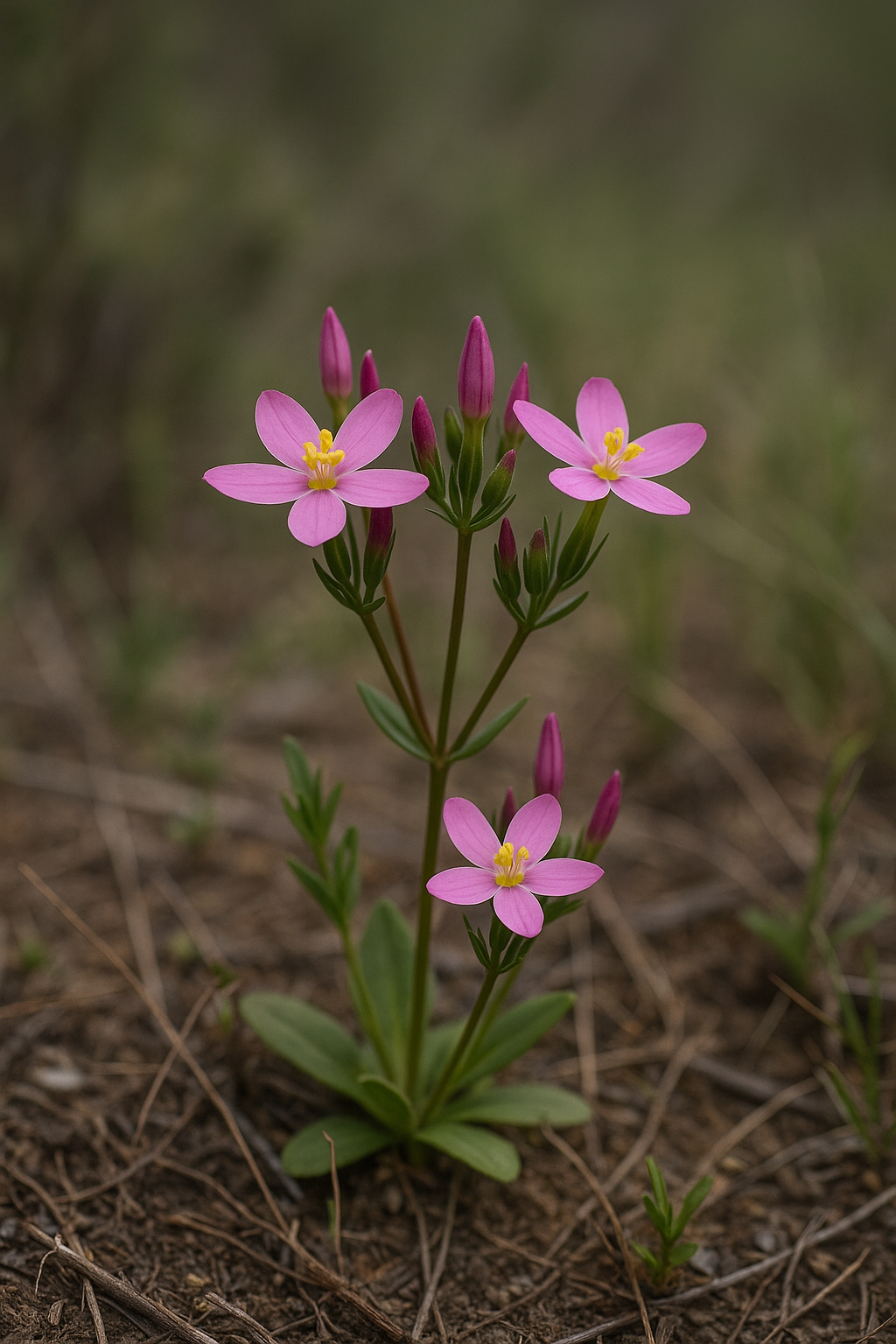
Growth form: A small, herbaceous annual or biennial plant that typically forms an open, erect or low-arching stem habit. Individual plants are generally compact in stature and often complete their life cycle within a single favorable season.
Flowers: The flowers typically present a tubular to funnel-shaped corolla with 4–6 lobes at the mouth, most commonly 5. Petal color is often pink to rose, sometimes paler toward the throat. Flowers are borne singly or in small clusters at stem tips or branch ends.
Leaves: Leaves are generally opposite on the stem and may be sessile or shortly petiolate; blades are usually lanceolate to oblong in shape. Basal leaves may form a loose rosette in some individuals.
Distinctive features: A combination of small stature, opposite leaves, and delicate pink, five-lobed corollas help distinguish Santa Catalina centaury from other local wildflowers. The corolla’s tubular base and contrasting lobes are characteristic of Centaurium species.
Seasonal variation: Plants often appear and flower in the season following winter or seasonal rains; foliage and flowering can be ephemeral and tied to local precipitation patterns.
Habitat & Distribution
Typical habitats: Often found in open habitats such as grasslands, scrub, and seasonally moist or rocky sites. Plants may occur in sandy or gravelly soils where competition is reduced.
Moisture, light, soil: Generally favors sunny to partly shaded locations with well-drained soils; can persist in sites that experience seasonal moisture followed by drier conditions.
Geographic distribution: Recorded in the southwestern United States, including Arizona, New Mexico, and Texas. Within this range, occurrences are often localized to suitable microhabitats.
Ecological Role
Pollinators: The tubular, nectar-bearing flowers are adapted to insect visitors; small bees and other short-tongued insects are common visitors to centaury-like flowers and likely serve as pollinators.
Wildlife interactions: Small herbivores may browse foliage opportunistically, but specific documented wildlife relationships for this species are limited.
Ecological niche: Functions as an early-season or opportunistic wildflower in open communities, taking advantage of pulses of moisture to grow and reproduce.
Human Uses & Cultural Significance
No well-documented, species-specific traditional or modern uses are widely cited for Centaurium nudicaule; genus-level medicinal uses exist for other Centaurium species, but species-specific claims are not asserted here.
Conservation & Interesting Facts
Conservation status is not widely listed at a national scale for this species; local occurrences may be rare or patchy. The genus name Centaurium references the mythical centaur Chiron, historically linked to medicinal plants in European herbal tradition. Many Centaurium species are adapted to complete rapid life cycles in response to seasonal moisture availability.
From Instagram