garden cornflower
Centaurea cyanus
BloomEDU
Identify it today. Know it next time.
Add garden cornflower to BloomEDU and a short quiz tomorrow will check if the name stuck.
Get BloomEDU — add garden cornflowerFree · iOS · Android
From Instagram
Identity & Classification
Centaurea cyanus L. — commonly called cornflower or bachelor's button — is an annual flowering plant in the family Asteraceae (the daisy/aster family).
Kingdom: Plantae
Order: Asterales
Family: Asteraceae
Genus: Centaurea
Species: cyanus
Taxonomic notes: the species was described by Linnaeus (hence the “L.” authority). Some taxonomists have treated a segregate genus Cyanus for the cornflower and close relatives, so you may see the name Cyanus cyanus in older or alternative treatments; however Centaurea cyanus remains the widely used name in many floras and horticultural sources.
Physical Description
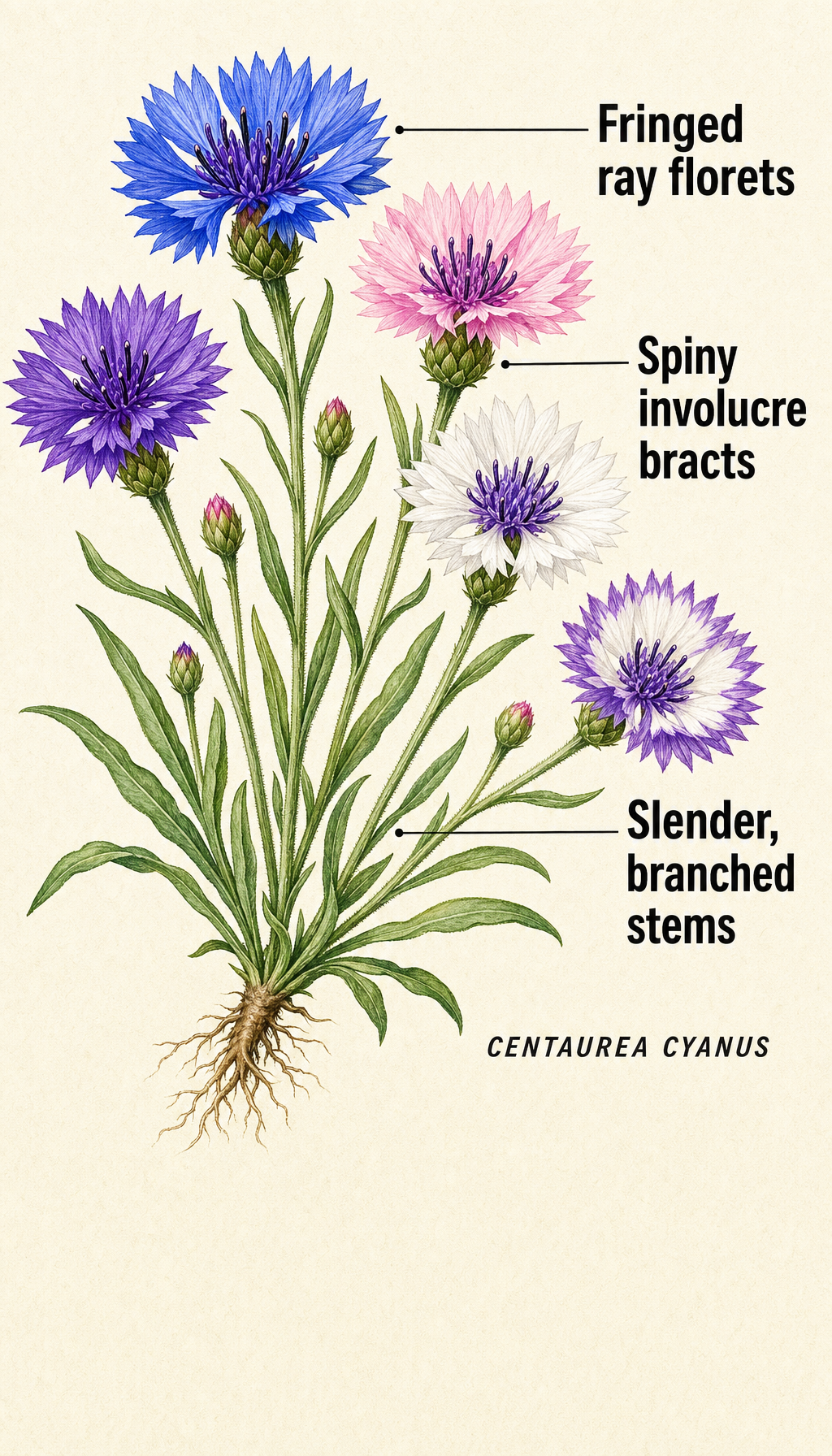
A compact, often striking annual with a distinctly “ragged” flower head. Key features at a glance:
Habit: Annual herb, typically erect and branching from the base. Plants often form a clump of stems rather than a single unbranched stalk.
Height: Usually within the range of a few tens of centimeters up to about 1 m in cultivated or vigorous individuals (commonly encountered around 30–90 cm).
Stems and leaves: Stems are erect, sometimes slightly rough; leaves are simple, lanceolate to oblong, more or less sessile (without long petioles) — lower leaves can be larger and sometimes toothed, upper leaves smaller and narrower.
Inflorescence: The conspicuous “flower” is actually a capitulum (flower head) typical of Asteraceae, made of many individual florets clustered on a receptacle. The overall look is a tufted, fringed head rather than a smooth daisy-like disk.
Florets and color: The showy parts are individual florets with narrow, often fringed lobes; the species is famous for its intense cobalt/azure blue form but also occurs in cultivated varieties of pink, white, purple and other hues.
Fruit: Produces single-seeded dry fruits (achenes or cypselae) following flowering. Seed heads are small and numerous.
Habitat & Range
Native range: Centaurea cyanus is native to temperate Europe and traditionally associated with arable fields (the historical association with “corn” refers to cereal grains such as wheat, barley, rye or oats).
Introduced/naturalized: It has become widely naturalised outside its native range and is commonly found in parts of North America and Australia following introduction as an ornamental and as a seed contaminant.
Preferred conditions: Typically found in sunny, open, disturbed habitats — historically in cereal fields and field margins, and now also in meadows, roadsides, gardens and other well-drained, open sites. It tolerates relatively poor soils and is frequently associated with disturbed ground.
Conservation note: In parts of its native European range, C. cyanus has declined and is considered endangered or rare in some areas due to agricultural intensification and heavy herbicide use that remove wildflower habitats.
Ecological Role
Pollination: Cornflower is an attractive source of nectar and pollen for a variety of insects. Bees (including solitary bees and bumblebees), butterflies and other pollinators commonly visit the florets.
Habitat value: In meadow and garden settings, it contributes to floral diversity and supports pollinator communities by providing floral resources through its flowering season.
Agricultural/ecological interactions: Historically present as a weed in cereal crops, its decline in arable habitats has been linked to reductions in field-edge wildflower diversity in intensively managed farmland. Specific specialist relationships (e.g., obligate insect dependents) are not well-documented for this species in the general literature.
Interesting Facts
That famous blue: The intense blue of the wild cornflower is relatively rare among flowers, which is why the species gained cultural prominence and horticultural interest. Garden cultivars expand the palette well beyond blue.
Name story: “Cornflower” comes from historical sightings in cereal (“corn” in the British sense) fields — in other words, it was the wildflower of grain fields, not modern maize. “Bachelor’s button” is a charming common name said to reference old-fashioned buttonhole flowers—an apt image for its button-like heads.
Natural mismatch: Although once common in traditional cereal fields, modern farming practices reduced its native populations — an example of how agricultural intensification can change plant communities.
Garden-friendly: It’s an easy annual for many gardens—tolerant of poor soils, self-seeding in favorable conditions, and a quick way to add pollinator-friendly color.
Color variety: While the classic wild form is blue, selective breeding and natural variation give you whites, pinks, purples and bi-colors in horticultural strains — a neat demonstration of how humans have shaped flower color via selection.