Castilleja californica
Castilleja californica
BloomEDU
Identify it today. Know it next time.
Add Castilleja californica to BloomEDU and a short quiz tomorrow will check if the name stuck.
Get BloomEDU — add Castilleja californicaFree · iOS · Android
Identity & Classification
Scientific name: Castilleja californica. Verified common names: California Indian paintbrush, California paintbrush. Family: Orobanchaceae (Castilleja has historically been placed in Scrophulariaceae). Genus: Castilleja. Castilleja species are hemiparasitic flowering plants and are closely related to other broomrape-family genera.
Visual Description
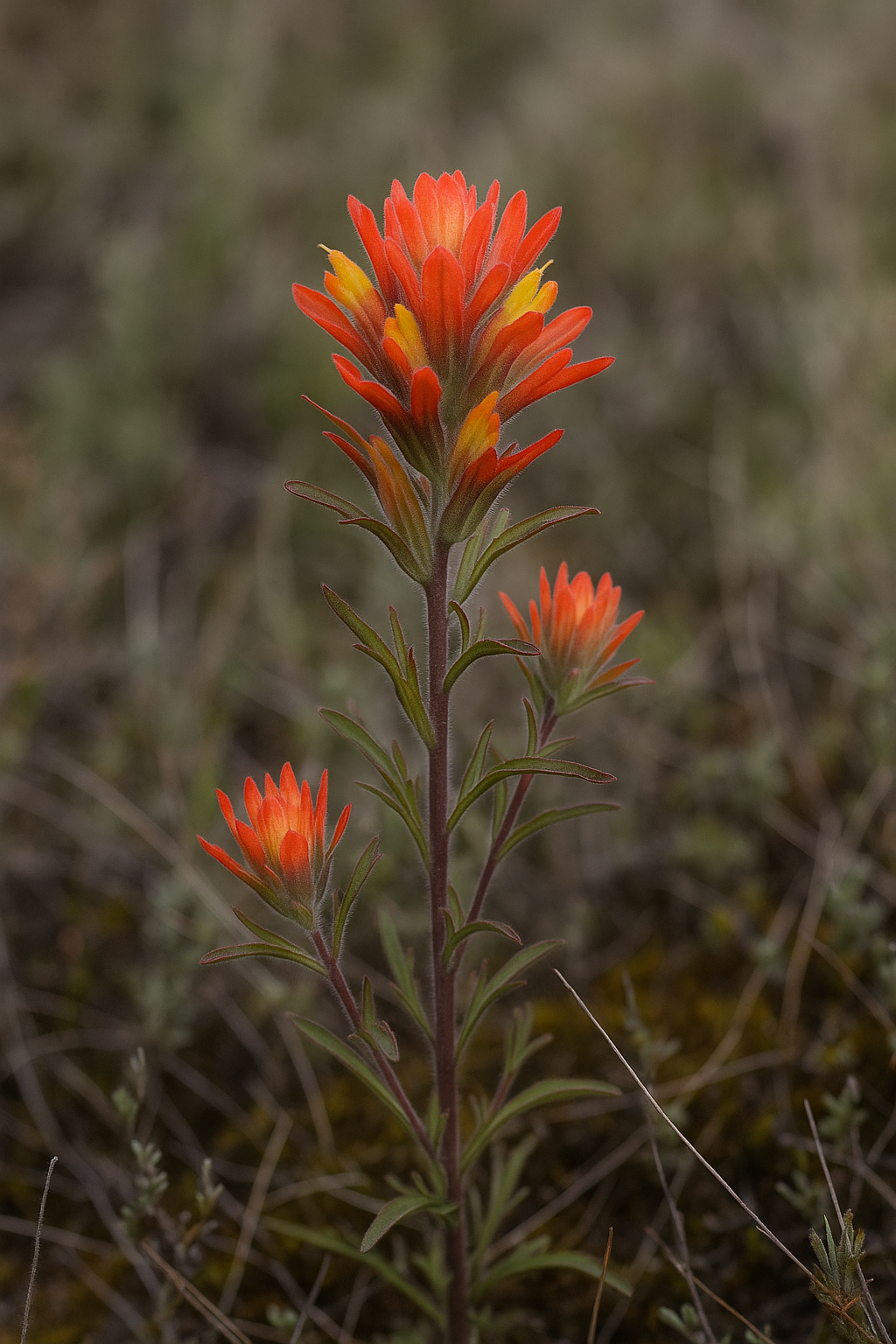
Overall form: A herbaceous, hemiparasitic plant that typically forms upright to slightly branching stems. Individual plants can range from low-growing to moderately tall depending on local conditions. Flower characteristics: Inflorescences are showy clusters in which the most conspicuous parts are brightly colored bracts (often red, orange, or yellow); the true flowers are tubular and generally bilabiate with fused petals, subtended and partially concealed by the bracts. Leaf structure and arrangement: Leaves are simple, usually lanceolate to linear or narrowly elliptic, typically arranged alternately along the stem though lower leaves may appear more clustered. Distinctive identifying features: Brilliantly colored leaf-like bracts that give the plant its “paintbrush” appearance and the species’ hemiparasitic habit (root haustoria that attach to nearby host plants). Stems and bracts may bear glandular or non-glandular hairs depending on local populations. Seasonal variation: Plants generally produce their colorful bracted inflorescences during the local flowering season, with foliage and stature varying according to moisture and exposure.
Habitat & Distribution
General growing conditions and ecosystems: Typically found in a variety of open habitats in California, often in grasslands, coastal bluffs and scrub, open slopes, and sometimes in vernal-pool margins or disturbed areas. Usual moisture, light, and soil preferences: Often occurs in full sun to partial shade on well-drained soils; tolerates a range from dry to mesic conditions depending on site. Geographic distribution: Native to California, where it is commonly associated with coastal and inland populations within the state.
Ecological Role
Pollination: Flowers and conspicuous bracts are adapted to attract pollinators; hummingbirds are well-documented pollinators of many red-flowered Castilleja species, and long-tongued bees also visit the tubular flowers. Wildlife interactions: As a hemiparasite, C. californica taps roots of neighboring plants (often grasses and forbs), influencing local plant community dynamics. Its floral displays provide nectar resources for pollinators.
Human Uses & Cultural Significance
Documented uses: Specific traditional or modern uses of Castilleja californica are not universally documented in the botanical literature and are therefore omitted here. Toxicity: Some Castilleja species can accumulate elements (for example, selenium) and may be unpalatable or toxic to livestock in areas with high soil element levels; such effects are site-dependent and not universal.
Conservation & Interesting Facts
Unique adaptations: Hemiparasitism via root haustoria and the evolution of brightly colored bracts (modified leaves) that visually advertise nectar-bearing flowers are notable adaptations. Fascinating fact: The showy “paintbrush” appearance comes mainly from bracts rather than the corolla itself, a strategy that concentrates visual signals for pollinators. Conservation status varies by locality and subspecies; sensitive populations may occur in fragmented habitats.
From Instagram