Cassandra calyculata
Cassandra calyculata
BloomEDU
Identify it today. Know it next time.
Add Cassandra calyculata to BloomEDU and a short quiz tomorrow will check if the name stuck.
Get BloomEDU — add Cassandra calyculataFree · iOS · Android
Identity & Classification
Cassandra calyculata — common name: leatherleaf (also treated in some floras under the genus Chamaedaphne) — family Ericaceae, genus Cassandra. Taxonomic treatments vary; the species is closely allied with other ericaceous bog shrubs.
Visual Description
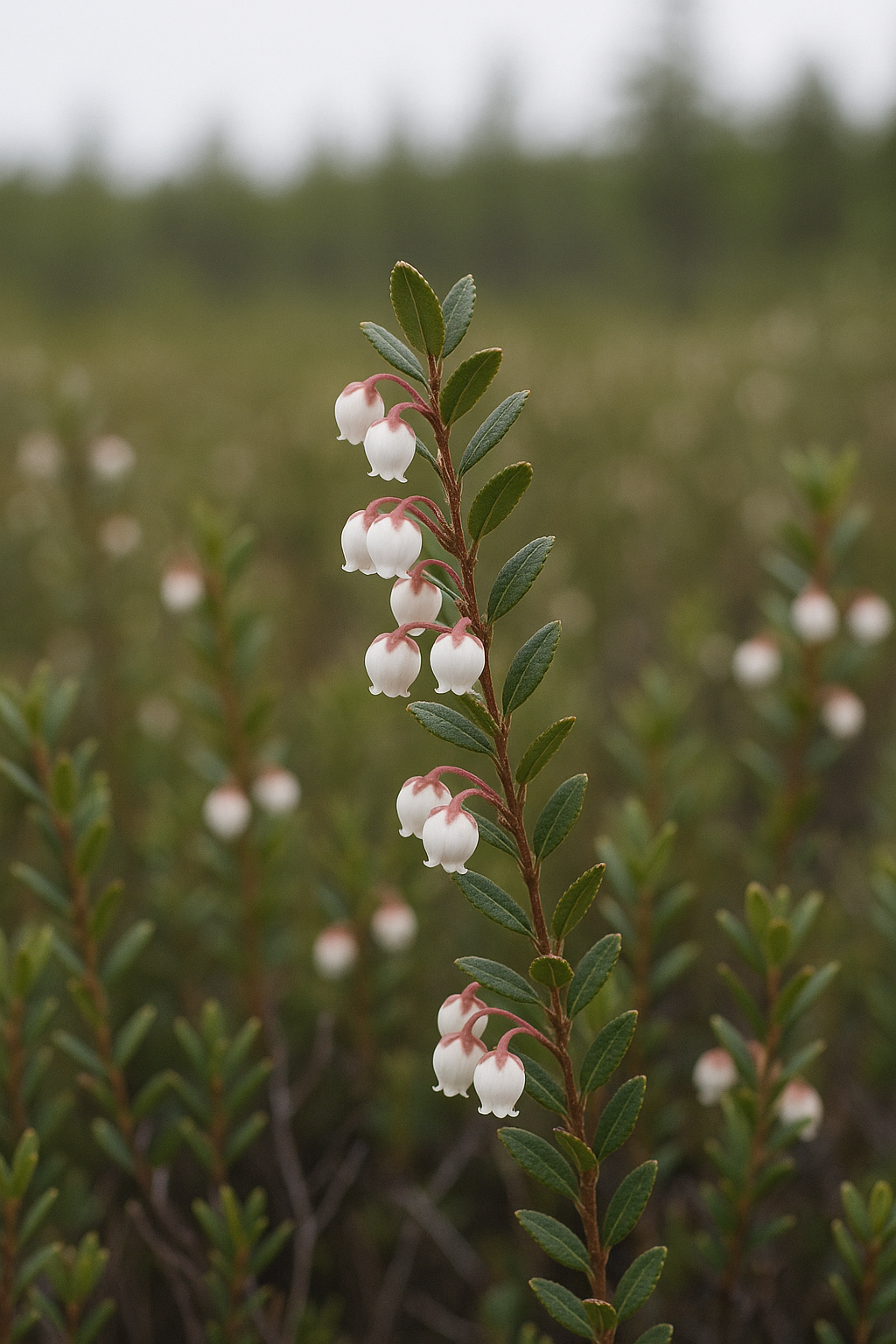
A low, evergreen shrub with a sprawling to erect habit, typically forming dense mats or hummocks in boggy ground. Plants are generally low-growing, often reaching roughly knee height in favorable sites. Leaves are alternate, simple, leathery and glossy, oblong to elliptic in outline with entire or slightly rolled-under margins; foliage often persists through the year and may darken or become bronzy in colder seasons. Flowers are borne in short racemes or clusters; blooms are urn-shaped (urceolate) to bell-like, usually white to pinkish, with fused petals forming a lobed mouth (commonly with five lobes). Flowering generally occurs in spring to early summer in most parts of the range. Fruits are small dry capsules that follow flowering and hold numerous small seeds. The combination of evergreen, leathery leaves and urn-shaped flowers is a useful field identifier.
Habitat & Distribution
Typically found in acidic, cold peatlands — bogs, poor fens, sphagnum mats, and other wet, oligotrophic (low-nutrient) habitats. Prefers saturated, peaty or peaty-sandy substrates and is commonly associated with open to partially shaded bog communities. Cassandra calyculata is recorded across northern North America and into temperate regions; within the United States it has been documented in Alaska, Connecticut, Delaware, Iowa, Illinois and at least 16 additional states, and it is commonly present across much of Canada. Plants favor acidic, poorly drained soils and persist in sites with low nutrient availability.
Ecological Role
Flowers are adapted for insect pollination and are frequently visited by bees (including bumblebees and other solitary bees) that can access the urn-shaped corollas. As a matrix-forming shrub in peatland communities, leatherleaf contributes to peat accumulation, stabilizes hummocks, and provides structural habitat for bog-associated invertebrates, birds, and other small fauna. The species typically occupies an ecological niche as a stress-tolerant, evergreen component of acid bog vegetation.
Human Uses & Cultural Significance
No widely documented, well-established modern or traditional uses are included here. Avoidance of speculation is advised.
Conservation & Interesting Facts
Cassandra calyculata is generally widespread where suitable bog habitat occurs and is not broadly regarded as globally threatened; local conservation status can vary with the loss or alteration of peatland habitats. Notable adaptations include leathery evergreen leaves and ericoid mycorrhizal associations that allow nutrient uptake in acidic, nutrient-poor peat soils, and urn-shaped flowers that favor bee pollinators adapted to accessing their nectar and pollen.
From Instagram