cattail sedge
Carex typhina
BloomEDU
Identify it today. Know it next time.
Add cattail sedge to BloomEDU and a short quiz tomorrow will check if the name stuck.
Get BloomEDU — add cattail sedgeFree · iOS · Android
Identity & Classification
Scientific name: Carex typhina
Verified common names: cattail sedge (commonly used); also called hairy sedge in some sources
Family: Cyperaceae
Genus: Carex
Carex typhina is a true sedge in the large Carex genus; it is not a grass (Poaceae) and is placed taxonomically within the sedges (Cyperaceae).
Visual Description
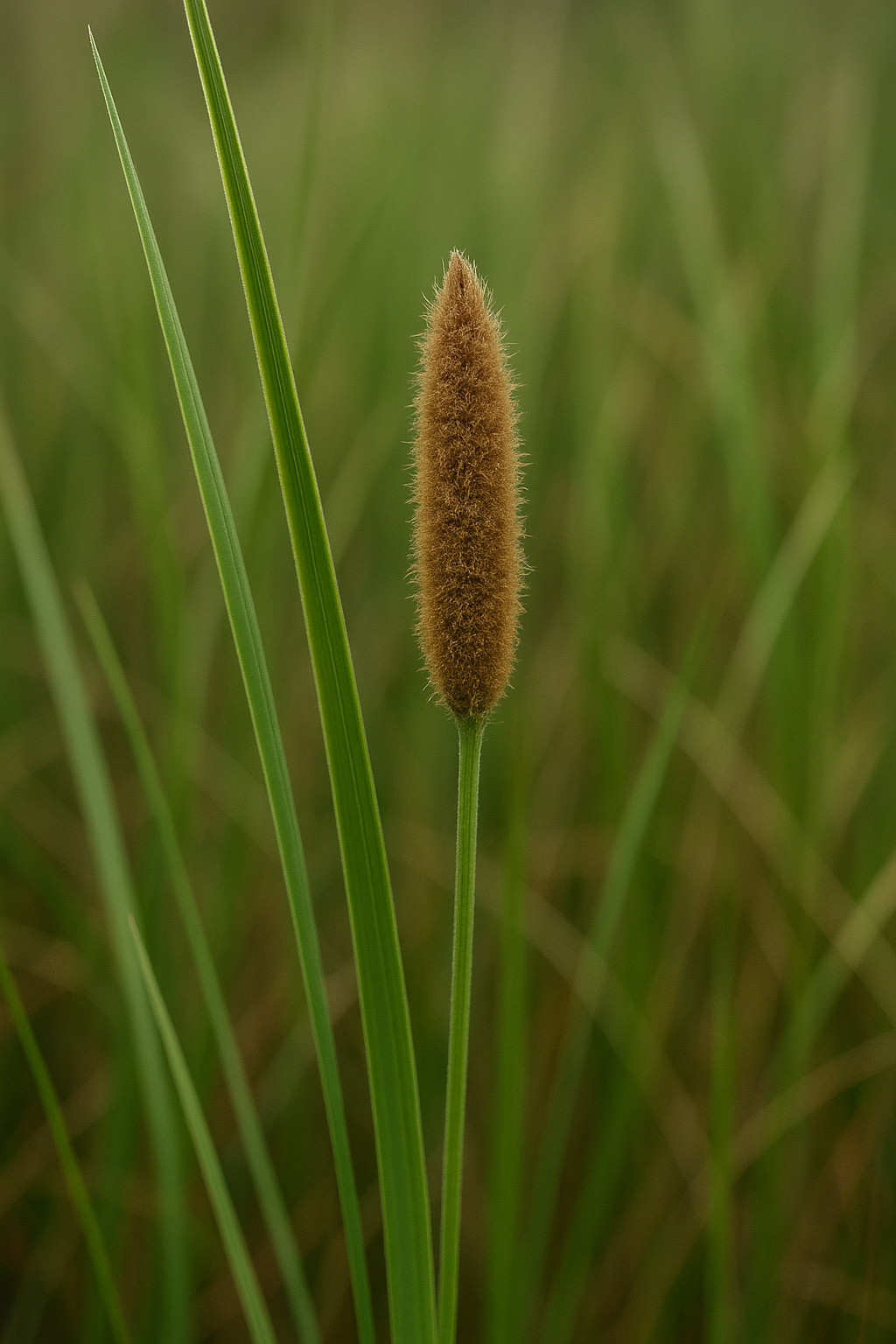
Carex typhina is a perennial, grasslike sedge that typically forms loose to moderately dense tussocks or clumps. Stems (culms) are triangular in cross-section, a distinguishing characteristic of sedges, and plants generally range from low to medium height for sedges (often forming conspicuous flowering spikes above the leaves). Flowers are reduced and wind-pollinated, lacking true petals or sepals; they occur in compact spikes composed of many small florets subtended by scales. Female flowers are enclosed in sac-like structures called perigynia (utricles), which for C. typhina are often noticeably fuzzy-hairy or coated with fine hairs, giving the inflorescence a soft, cattail-like appearance—hence the common name. Inflorescences may have a terminal staminate (male) spike and one or several pistillate (female) spikes or a combined spike cluster, depending on the individual. Leaves are grasslike, arising from the base, usually narrow and flat to slightly folded, with the sheaths typical of Carex. Seasonal variation: flowering and seedset typically occur in spring to early summer, after which the brownish perigynia persist into summer and sometimes fall, aiding identification.
Habitat & Distribution
Carex typhina is typically found in moist to wet habitats—wet meadows, marsh edges, swales, floodplain forests, and the margins of ponds and streams—but it can also occur in seasonally damp fields and grassy wetlands. It generally prefers full to partial sun and moist, organic or mineral soils; tolerance for standing water may vary locally. Geographic distribution is primarily in the eastern and central United States; it is recorded in Alabama, Arkansas, Connecticut, Delaware, Florida and roughly 26 additional U.S. states, indicating a fairly broad but regionally patchy range.
Ecological Role
Like most sedges, C. typhina is wind-pollinated. It often contributes to wetland structure by forming clumps that stabilize soil and provide microhabitat. Seeds and foliage may be used as forage by various wetland birds and small mammals, while the dense tussocks offer shelter for invertebrates and ground-nesting species.
Human Uses & Cultural Significance
There are no widely documented traditional or widespread modern uses specific to Carex typhina in mainstream botanical literature; it is primarily valued ecologically for wetland restoration and habitat planting where sedges are used.
Conservation & Interesting Facts
Conservation status can vary by state and locality; C. typhina may be uncommon or of conservation concern at range margins. A notable botanical feature is the species’ hairy perigynia—an adaptation that can aid seed presentation and identification and is characteristic of several Carex species. Carex species’ distinctive perigynium is a key trait that separates the genus from other sedges.
From Instagram