Canterbury bells
Campanula medium
BloomEDU
Identify it today. Know it next time.
Add Canterbury bells to BloomEDU and a short quiz tomorrow will check if the name stuck.
Get BloomEDU — add Canterbury bellsFree · iOS · Android
Identity & Classification
Scientific name: Campanula medium L.
Common names: Canterbury bells, Canterbury-bell (often styled as a singular)
Family: Campanulaceae
Genus: Campanula — a group of bellflowers including many horticultural and wild species. Campanula medium is a well-known garden species within this genus.
Visual Description
Form and size: A biennial or short-lived perennial typically producing a basal rosette the first year and erect flowering stems the following season. Plants generally reach a moderate height (often about 1–3 feet/30–90 cm) with an upright habit.
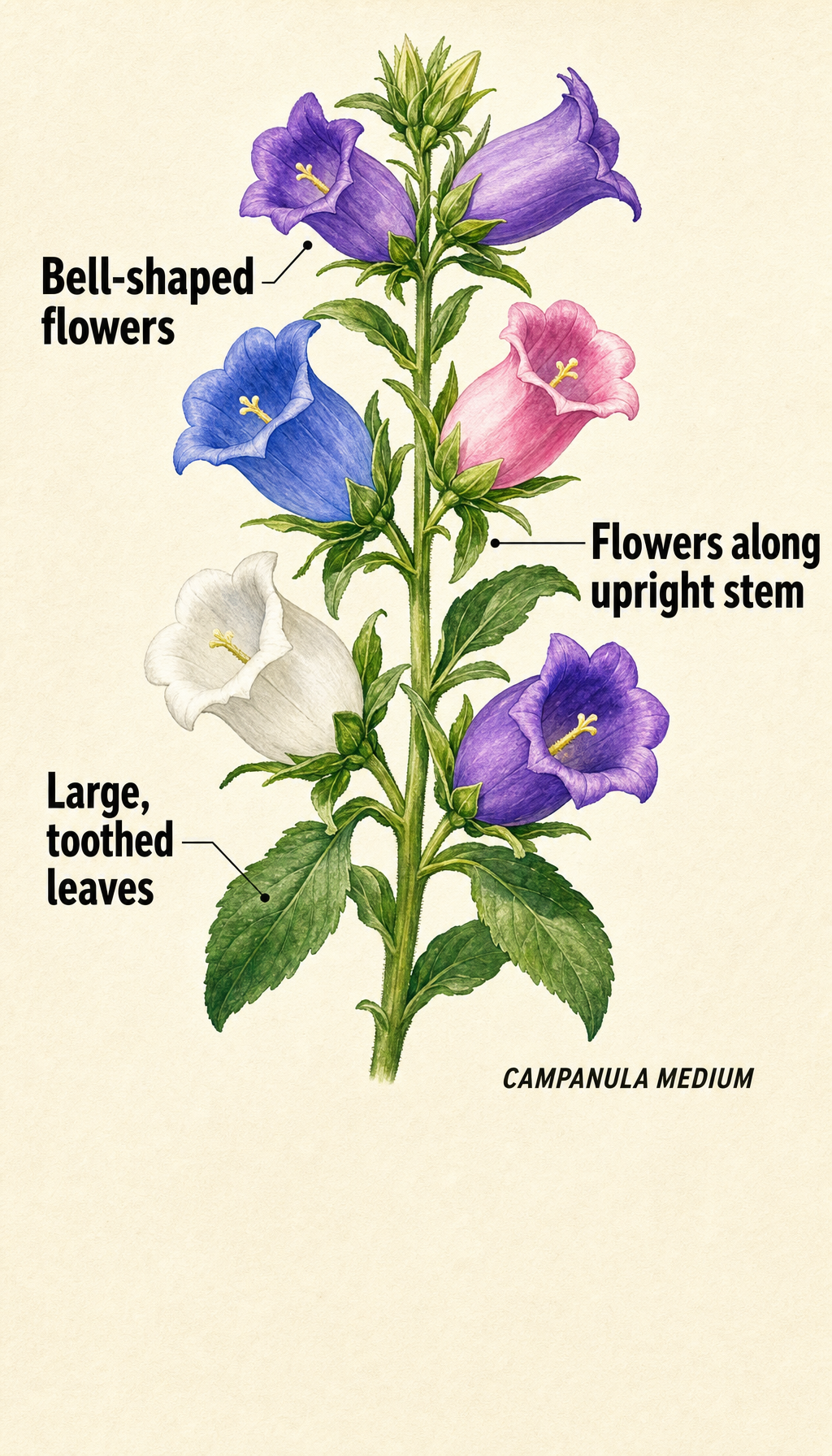
Flowers: Large, showy, bell-shaped corollas that are typically 4–6-lobed (most commonly 5-lobed), produced singly or in loose terminal racemes. Flower forms include single and double cultivars; colors often include shades of blue to violet, pink, and white. Flowers usually face outward or slightly downward.
Leaves: Basal leaves form a rosette and are typically oblong to ovate with toothed margins; stem (cauline) leaves are alternate, smaller, and may clasp the stem or be toothed.
Distinctive features: Large, pendulous bell-shaped flowers in striking colors and a biennial growth pattern distinguish C. medium from many other garden campanulas. Double-flowered cultivars produce dense, rose-like bloom clusters.
Seasonal variation: Foliage predominates in the first year (rosette); flowering typically occurs in the following spring to summer season, with seed set and senescence following flowering in many biennial forms.
Habitat & Distribution
Growing conditions: Commonly cultivated in garden beds, borders, and cottage-garden settings; typically prefers full sun to partial shade and well-drained, moderately fertile soil. Plants often do well in temperate garden conditions with regular moisture but not prolonged waterlogging.
Geographic distribution: Native to parts of Europe and widely cultivated and naturalized in gardens abroad. In the United States it is reported from California, Connecticut, Michigan, Montana, Oregon, and one additional state. In cultivation it is commonly grown beyond recorded naturalized occurrences.
Ecological Role
Pollinators: Bell-shaped flowers are well-suited to bees, including bumblebees and other long-tongued bees, which commonly visit for nectar and pollen.
Wildlife interactions: Serves primarily as a nectar and pollen resource in garden habitats; not a major forage plant for large herbivores.
Human Uses & Cultural Significance
Primarily an ornamental plant long valued in garden culture for its large, colorful flowers and suitability for mixed borders and cottage gardens. Widely grown from seed, including single and double cultivars selected for bloom form and color.
Conservation & Interesting Facts
Not generally regarded as a species of conservation concern in cultivation and widely available in horticulture. The characteristic bell-shaped corolla is an adaptation that favors bee pollination by providing a sheltered landing and concentrated nectar source. The dramatic single and double flower forms in gardens represent centuries of selection and breeding for ornamental display.
From Instagram