heart of Jesus
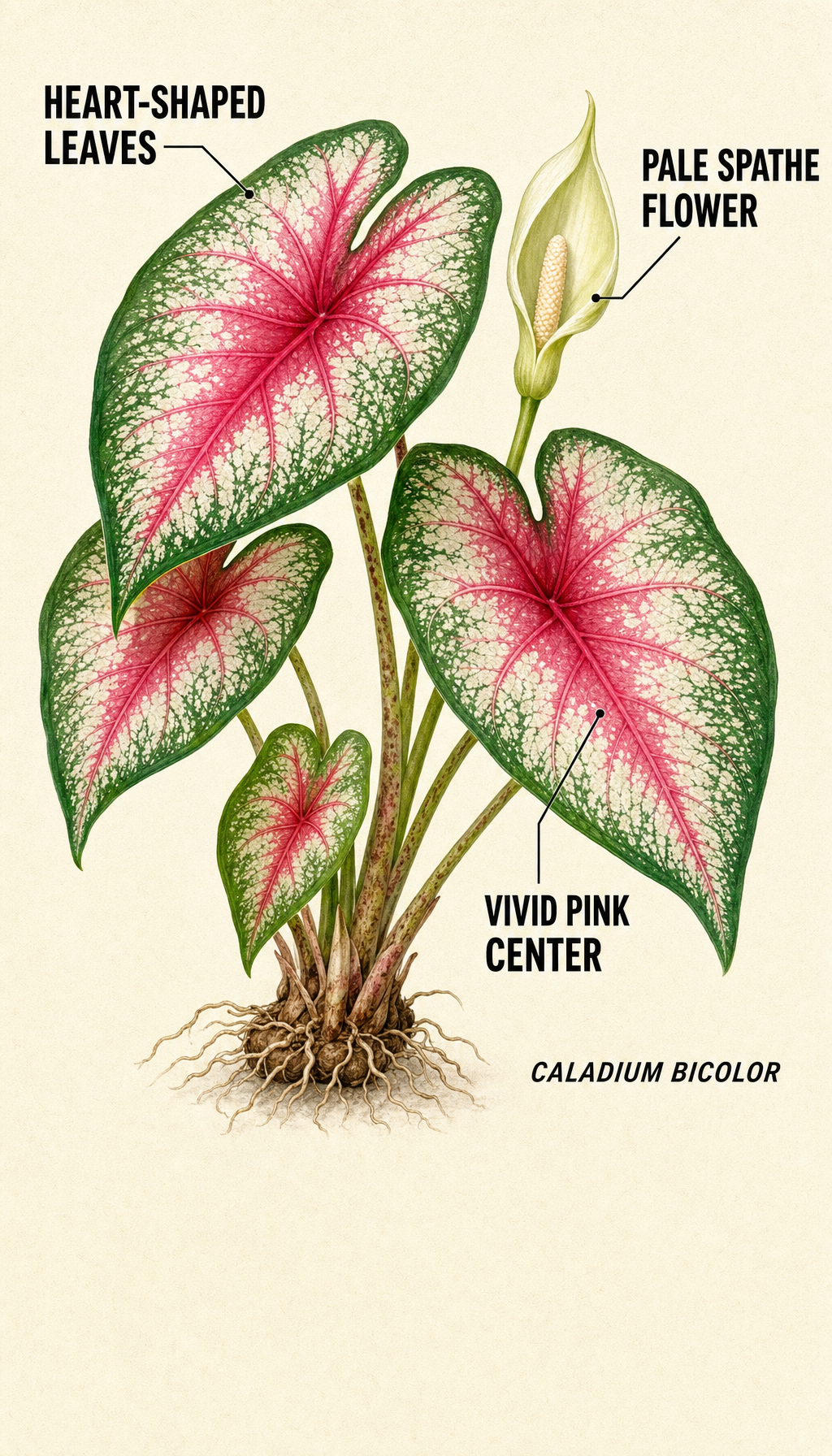
Caladium bicolor
BloomEDU
Identify it today. Know it next time.
Add heart of Jesus to BloomEDU and a short quiz tomorrow will check if the name stuck.
Get BloomEDU — add heart of JesusFree · iOS · Android
Identity & Classification
- Scientific name: Caladium bicolor
- Verified common names: heart of Jesus, caladium, fancy-leaf caladium
- Family: Araceae
- Genus: Caladium
- Taxonomic note: Caladium bicolor is the type species of the horticulturally important Caladium genus within the arum family (Araceae).
Visual Description
- Overall form: A tuberous perennial grown primarily for its foliage. Plants form a clump of petiolate leaves arising from an underground tuberous rhizome.
- Size: Mature plants typically reach about 20–60 cm in height, with individual leaves often falling within a moderate size range depending on cultivar.
- Leaf structure and arrangement: Leaves are heart-shaped to arrowhead-shaped, borne singly on long petioles in a basal rosette. Leaf blades commonly show strong central and radiating venation.
- Color and patterns: Leaf coloration is highly variable and the principal ornamental trait—patterns may include combinations of green, white, pink, red, and cream with contrasting veins and blotches; cultivars are selected for striking variegation.
- Flower characteristics: Inflorescences are typical of Araceae—an erect spadix subtended by a spathe. Flowers are generally small and inconspicuous compared with the foliage, often greenish-white to pale and not a primary ornamental feature.
- Seasonal variation: In cooler or drier conditions plants may enter dormancy and tubers remain dormant until warmer, wetter periods; in warm, humid climates foliage may persist year-round.
Habitat & Distribution
- General conditions: Often associated with shaded, humid environments. Commonly grown in shade gardens, containers, and as understory ornamentals in gardens and landscapes.
- Moisture, light, soil: Generally prefers consistently moist, well-drained, humus-rich soils and dappled to full shade; many cultivars perform poorly in prolonged direct sun.
- Geographic distribution: Cultivated widely and commonly encountered in landscapes and gardens in Florida and Louisiana; originates from the tropical Americas and is adapted to warm, humid conditions.
Ecological Role
- Pollination: Produces the aroid-type inflorescence that is typically insect-pollinated; specific pollinator relationships are generally with small insects attracted to the spadix in Araceae.
- Wildlife interactions: Not a major wildlife forage plant; the plant contains crystalline irritants that deter herbivory.
Human Uses & Cultural Significance
- Primary use: Widely grown as an ornamental for its colorful foliage and as a container/landscape plant.
- Toxicity: All parts contain calcium oxalate crystals and are considered toxic if chewed or ingested, causing oral irritation and swelling; handling may cause skin irritation in sensitive individuals.
Conservation & Interesting Facts
- Conservation: Not generally regarded as a conservation concern in cultivation; many cultivars exist from extensive horticultural selection.
- Interesting facts: Caladiums store energy in tubers and commonly undergo seasonal dormancy; the spectacular leaf variegation in cultivated forms is the primary reason for their widespread popularity.
From Instagram