American bluehearts
Buchnera americana
BloomEDU
Identify it today. Know it next time.
Add American bluehearts to BloomEDU and a short quiz tomorrow will check if the name stuck.
Get BloomEDU — add American blueheartsFree · iOS · Android
Identity & Classification
Scientific name: Buchnera americana L.
Common names: American bluehearts, bluehearts
Family: Orobanchaceae (historically treated in Scrophulariaceae)
Genus: Buchnera
Note: Modern treatments place Buchnera in the broomrape family (Orobanchaceae); older floras sometimes list it in Scrophulariaceae.
Visual Description
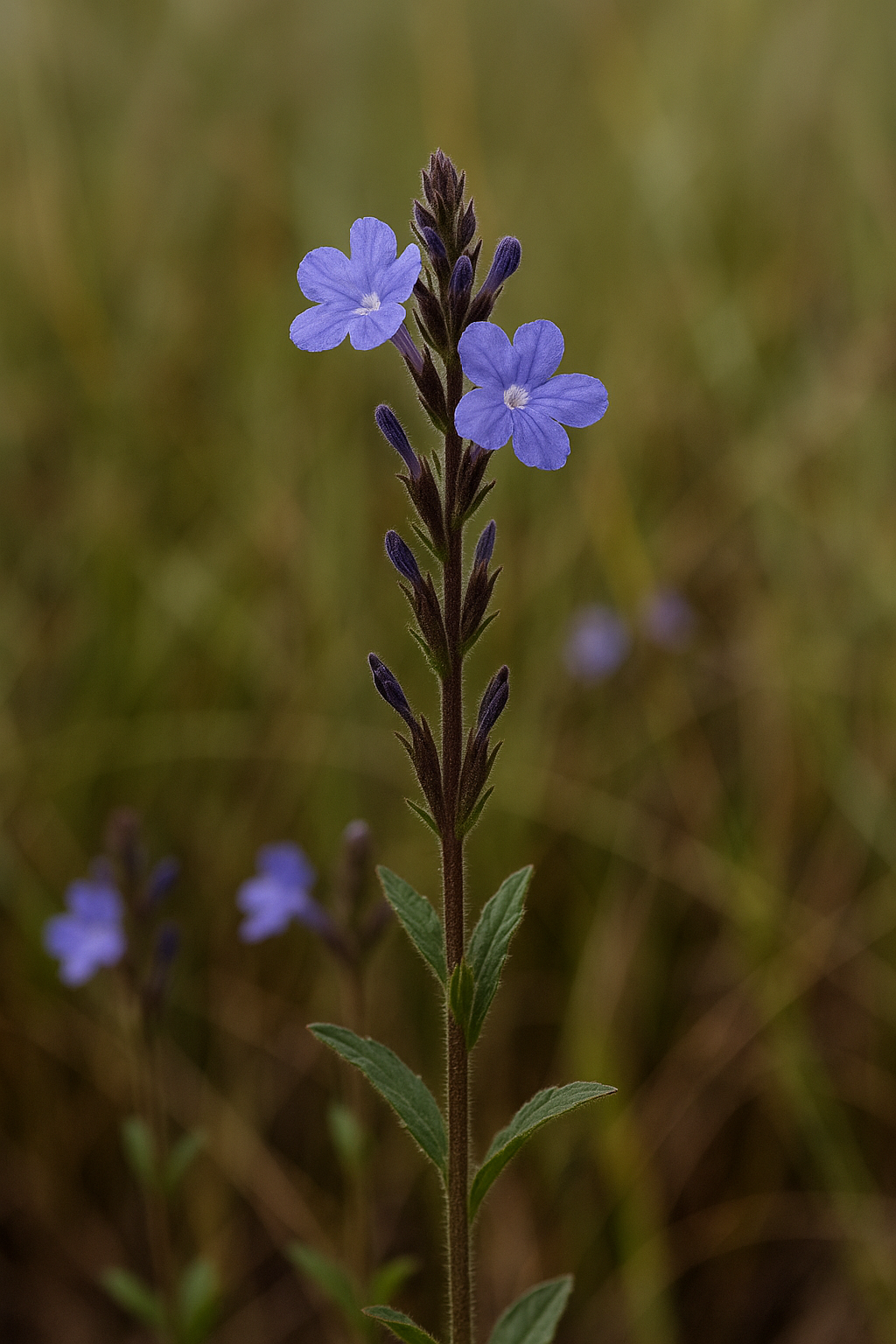
Overall form: A herbaceous perennial (often behaving as a short-lived perennial or biennial in some sites) with an erect, branching stem producing one or more terminal flower spikes. Plants are typically low- to medium-height and commonly form loose clumps.
Flowers: Inflorescences are dense terminal spikes of tubular, two-lipped (bilabiate) flowers. Flowers are typically blue to purple (occasionally paler shades) and show a conspicuous lower lip that may be three-lobed, with the corolla formed from fused petals. Individual flowers are relatively small but abundant in the spike, giving a striking blue columnar appearance.
Leaves: Leaves are simple and typically arranged opposite on the stem (sometimes appearing alternate on short shoots), lanceolate to elliptic in shape and generally toothed to entire along the margins. Leaves may be sessile or have short petioles.
Distinctive features: The combination of bright blue–purple tubular bilabiate flowers borne in dense terminal spikes and opposite lance-shaped leaves distinguishes American bluehearts from many other native wildflowers. Small leafy bracts often subtend the individual flowers on the spike.
Seasonal variation: Flowering generally occurs in summer into early fall, with vegetative growth before and after the bloom period; foliage and stem vigor can vary with site moisture and light.
Habitat & Distribution
Habitat: Typically found in moist to mesic open habitats such as wet meadows, bog margins, seeps, swales, pine flatwoods, roadside ditches, and other seasonally damp or acidic sites. It is often associated with open, sunny to partly shaded areas.
Soil, moisture, light: Often prefers moist, well-drained to seasonally wet soils and tolerates acidic substrates; commonly occurs in full sun to partial shade.
Geographic distribution: Native to the eastern and adjacent central United States; recorded in a number of states including AL, AR, DE, FL, GA and many others across its range in the eastern U.S.
Ecological Role
Pollination: Flowers are adapted for pollination by bees and other long-tongued insect visitors; tubular bilabiate corollas commonly attract bees that can access nectar and pollen.
Parasitic habit: Species in the genus Buchnera are often hemiparasitic on nearby plant roots, forming haustorial connections to obtain water and nutrients while still photosynthesizing; B. americana is commonly described as a facultative root hemiparasite.
Wildlife interactions: As a nectar source, it contributes to late-summer forage for native pollinators.
Human Uses & Cultural Significance
No widely documented modern uses or well-established traditional medicinal uses are broadly cited in standard botanical references; omit speculative uses.
Conservation & Interesting Facts
Conservation: Not generally listed as globally threatened; local conservation status can vary with habitat loss and wetland drainage.
Interesting facts: The genus’s hemiparasitic habit is an important ecological adaptation that can allow Buchnera to persist in nutrient-poor soils by tapping nearby plants. The vivid blue–purple flowering spikes make American bluehearts a visually distinctive component of late-summer wetland flora.
From Instagram