tuba milkweed
Asclepias tomentosa
BloomEDU
Identify it today. Know it next time.
Add tuba milkweed to BloomEDU and a short quiz tomorrow will check if the name stuck.
Get BloomEDU — add tuba milkweedFree · iOS · Android
From Instagram
Identity & Classification
Scientific name: Asclepias tomentosa
Common names: tuba milkweed, woolly milkweed (also referred to as tomentose milkweed)
Family: Asclepiadaceae
Genus: Asclepias
Note: Asclepias is the milkweed genus; taxonomic treatments sometimes place this group within Apocynaceae as the subfamily Asclepiadoideae, but Asclepias remains the accepted genus for these milkweeds.
Visual Description
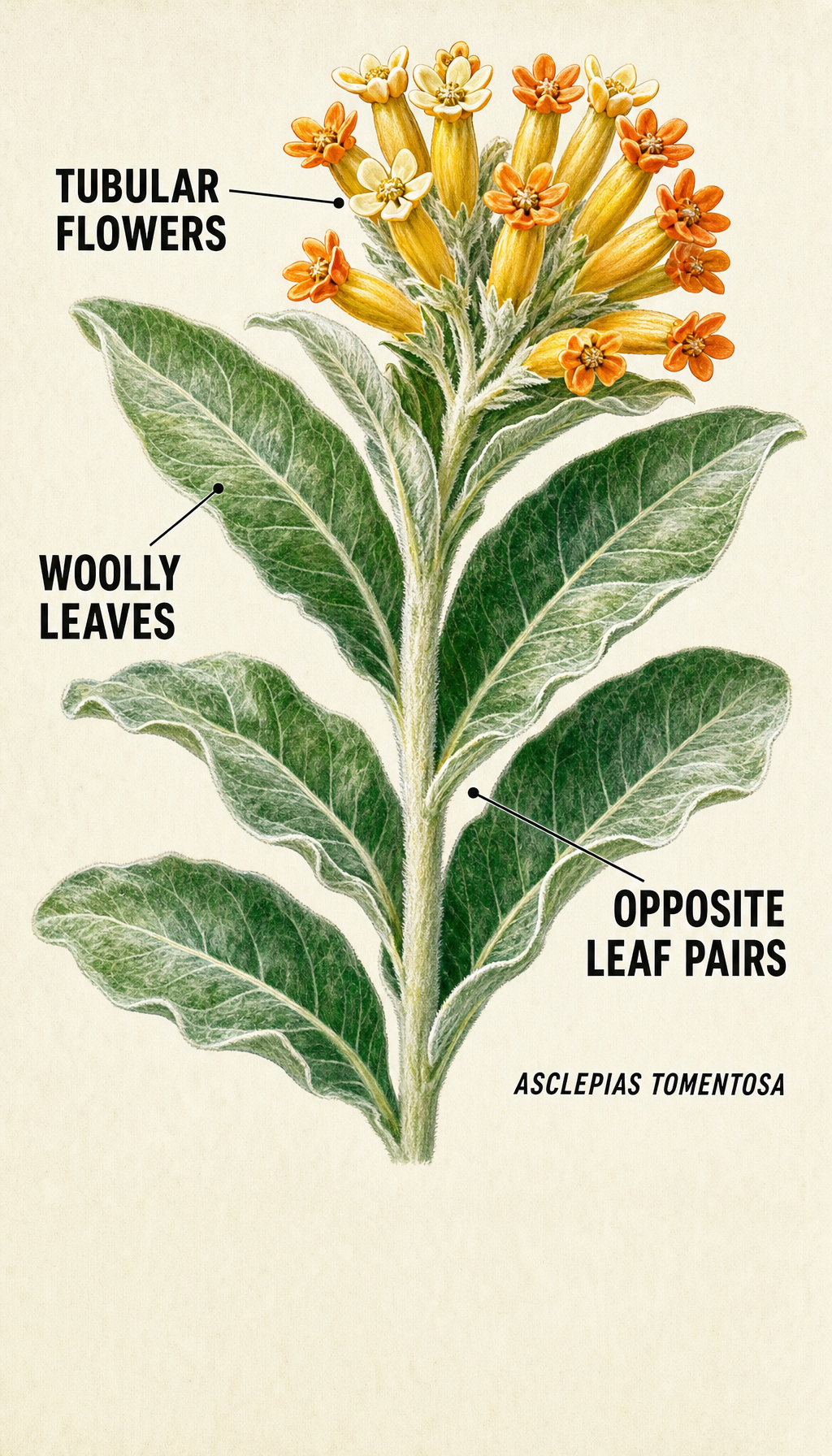
A low-growing, often sprawling perennial with stems and leaves densely covered in whitish to grayish hairs (tomentum), giving the plant a felted or woolly appearance. Stems may be erect to decumbent and generally remain relatively low to the ground. Leaves are opposite, leathery to slightly succulent in texture, and lanceolate to elliptic in shape; they are typically hairy on both surfaces. Flowers are produced in small, rounded clusters (umbels or cymes); each flower has the characteristic milkweed structure with five reflexed corolla lobes and a central corona composed of hoods and horns. Flower color is often yellow to orange or cream, sometimes appearing muted by the plant’s dense pubescence. Fruits are paired follicles typical of milkweeds, containing flat seeds with silky hairs (coma) adapted for wind dispersal. Seasonal display: flowering generally occurs during the warm season in its range, with the woolly foliage remaining conspicuous outside bloom.
Habitat & Distribution
Typically found in sandy, well-drained sites of the southeastern United States, often on coastal plain habitats such as scrub, sandhills, dunes, pine flatwoods, and open sandy fields. Prefers full sun to partial sun and is adapted to dry, nutrient-poor soils; drought-tolerant tendencies are common. Documented from Alabama, Florida, Georgia, North Carolina, South Carolina and one additional nearby state, reflecting a primarily southeastern coastal plain distribution.
Ecological Role
As a milkweed, it exhibits the specialized pollination syndrome of the genus: insect visitors (bees, wasps, butterflies and other floral-foraging insects) can remove and transfer pollinia, effecting pollination. The flowers provide nectar to a variety of pollinators, and the plant’s foliage may serve as a larval food source for milkweed-specialist caterpillars in the region, including monarchs and other danaine butterflies, though use can vary locally. Seeds are wind-dispersed via silky comas.
Conservation & Interesting Facts
The dense tomentum (woolly hairs) is a notable adaptation that helps reduce water loss, reflect intense sunlight and may deter some herbivores. Milkweeds possess a distinctive pollination mechanism involving pollinia—pollen packaged into discrete masses that attach to insect visitors—an unusual strategy among flowering plants.