showy milkweed
Asclepias speciosa
BloomEDU
Identify it today. Know it next time.
Add showy milkweed to BloomEDU and a short quiz tomorrow will check if the name stuck.
Get BloomEDU — add showy milkweedFree · iOS · Android
From Instagram
Identity & Classification
Asclepias speciosa — commonly called showy milkweed — is a milky‑sapped perennial in the dogbane family. Taxonomic placement (high level):
Kingdom: Plantae
Clade: Angiosperms → Eudicots → Asterids
Order: Gentianales
Family: Apocynaceae (formerly treated in the separate milkweed family, Asclepiadaceae)
Genus: Asclepias
Species: Asclepias speciosa
Common names: showy milkweed (primary). Taxonomic notes: Asclepias species share the distinctive milkweed floral structure (corolla + corona with hoods and horns) and the milky latex in stems and leaves that gives the group its common name.
Physical Description
A charismatic, easily recognized native milkweed with large flower clusters and broad leaves. Key characteristics:
Growth form: perennial herbaceous plant, often forming erect stems in clumps (may spread to form colonies).
Height: typically a medium‑sized herb; often reaches around waist to chest height (plants commonly around 1–5 feet tall, depending on site and season).
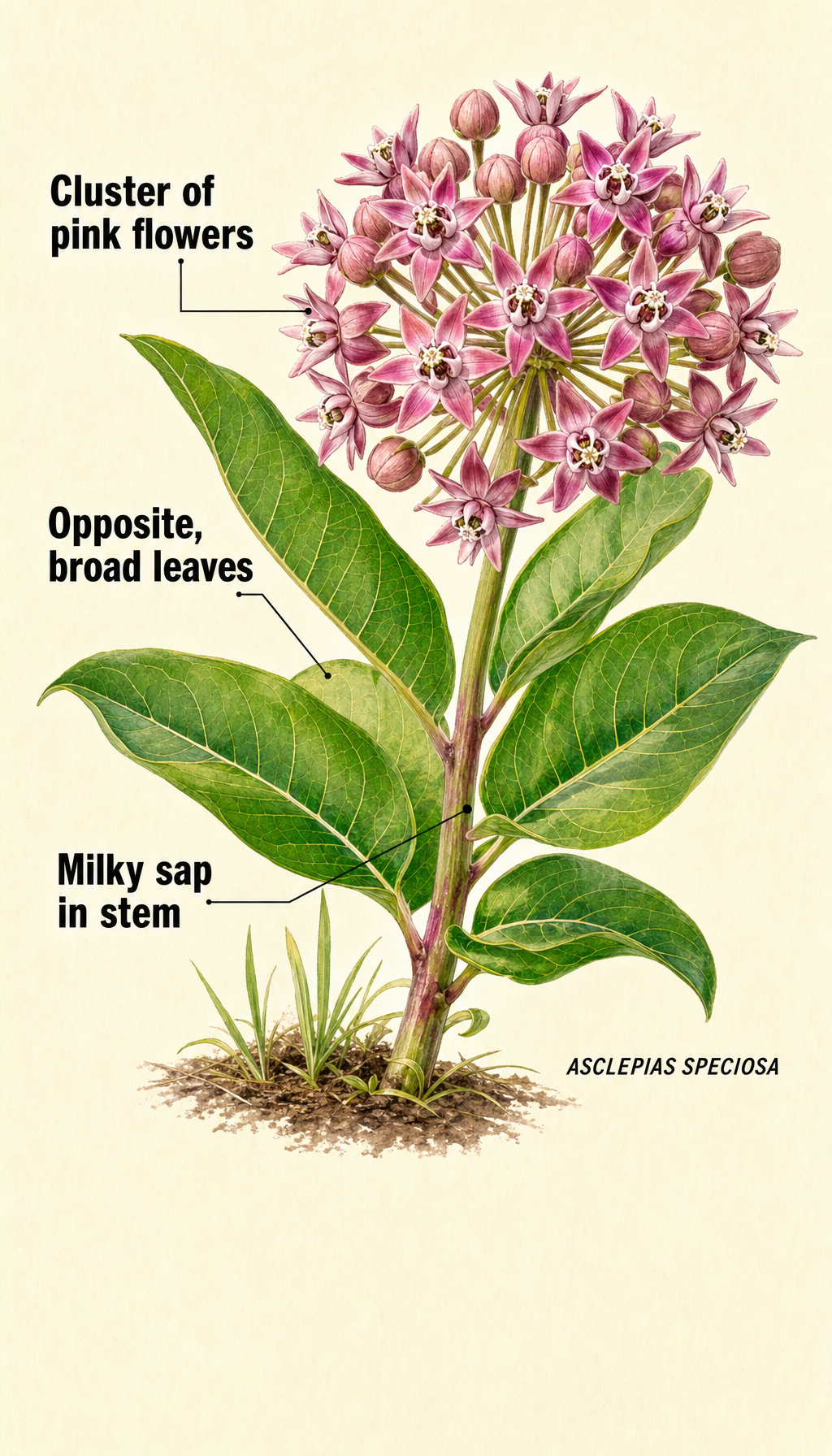
Stems & sap: stems contain a white, latex‑rich sap (the classic “milk” of milkweeds). Stems are often stout and may be softly downy.
Leaves: opposite, broad, ovate to elliptic leaves; the foliage is relatively large compared with many other Asclepias species and may be somewhat fuzzy or downy on the underside.
Flowers: showy, rounded umbels (ball‑like clusters) of many pink to mauve flowers; each flower has the typical milkweed design — a reflexed corolla and a corona made of hoods and horns — which is a mechanical and visual cue for pollinators. Flowers are often scented.
Fruit & seed: fruits are elongated follicles (pods) that split open at maturity to release seeds attached to silky hairs (coma), which aid wind dispersal.
Habitat & Range
General distribution: native to western North America. It occurs naturally in parts of western Canada and the western United States (west of the Great Plains), though precise local limits vary by source and local conditions.
Typical habitats: open sites such as meadows, prairies, streambanks, roadsides, rangeland and other disturbed or semi‑natural openings.
Growing conditions: usually found in sunny to partly sunny locations, tolerates a range of soil types and is relatively drought‑tolerant once established. It commonly occupies well‑drained soils but can be found in a variety of moisture regimes depending on local conditions.
Ecological Role
Showy milkweed is a keystone-like native plant in many western ecosystems because of its multiple wildlife interactions:
Host plant for monarch butterflies (Danaus plexippus): monarch caterpillars feed on milkweed foliage and incorporate milkweed compounds into their chemistry — many conservation programs promote Asclepias species, including showy milkweed, to support monarchs.
Supports a suite of specialized insects: various milkweed specialists (milkweed bugs, milkweed beetles and other herbivores) use milkweeds for food or breeding; a wide range of generalist and specialist pollinators visit the nectar.
Pollination: milkweed flowers present pollen as pollinia (cohesive pollen packets). Pollinators visiting the flowers can become attached to the pollinia and transfer them between plants — a distinctive and somewhat elaborate pollination mechanism.
Seed dispersal and recruitment: seeds with silky hairs are dispersed by wind; plants may also spread locally by rhizomes or clumping growth, forming patches that provide concentrated resources for insects.
Interesting Facts
“Showy” is not exaggeration: the species name speciosa means “showy” or “beautiful,” a nod to the large, colorful flower clusters that are hard to miss in bloom.
Floral engineering: milkweed flowers don’t shed loose pollen — they package pollen into pollinia. Visiting insects can pick up these pollen packets on their legs and body, creating a very efficient, if mechanical, pollination system.
Chemical defense and theater: the milky latex contains defensive chemicals that deter many herbivores. Some specialist insects (notably monarch caterpillars) tolerate and sequester these compounds for their own defense — an elegant evolutionary arms race.
Seed parachutes: when the pods split, each seed carries a tuft of silky hairs that acts like a tiny parachute, letting the wind carry the next generation away.
Garden-friendly wildlife magnet: planting showy milkweed is a practical, visible way to create habitat for pollinators and monarchs in suitable parts of North America.