island sagebrush
Artemisia nesiotica
BloomEDU
Identify it today. Know it next time.
Add island sagebrush to BloomEDU and a short quiz tomorrow will check if the name stuck.
Get BloomEDU — add island sagebrushFree · iOS · Android
From Instagram
Identity & Classification
Scientific name: Artemisia nesiotica
Verified common name: island sagebrush
Family: Asteraceae
Genus: Artemisia
Taxonomic notes: A member of the wormwood/sagebrush genus Artemisia; relationships with other California Artemisia are morphological and ecological rather than identical in habitat or form
Visual Description
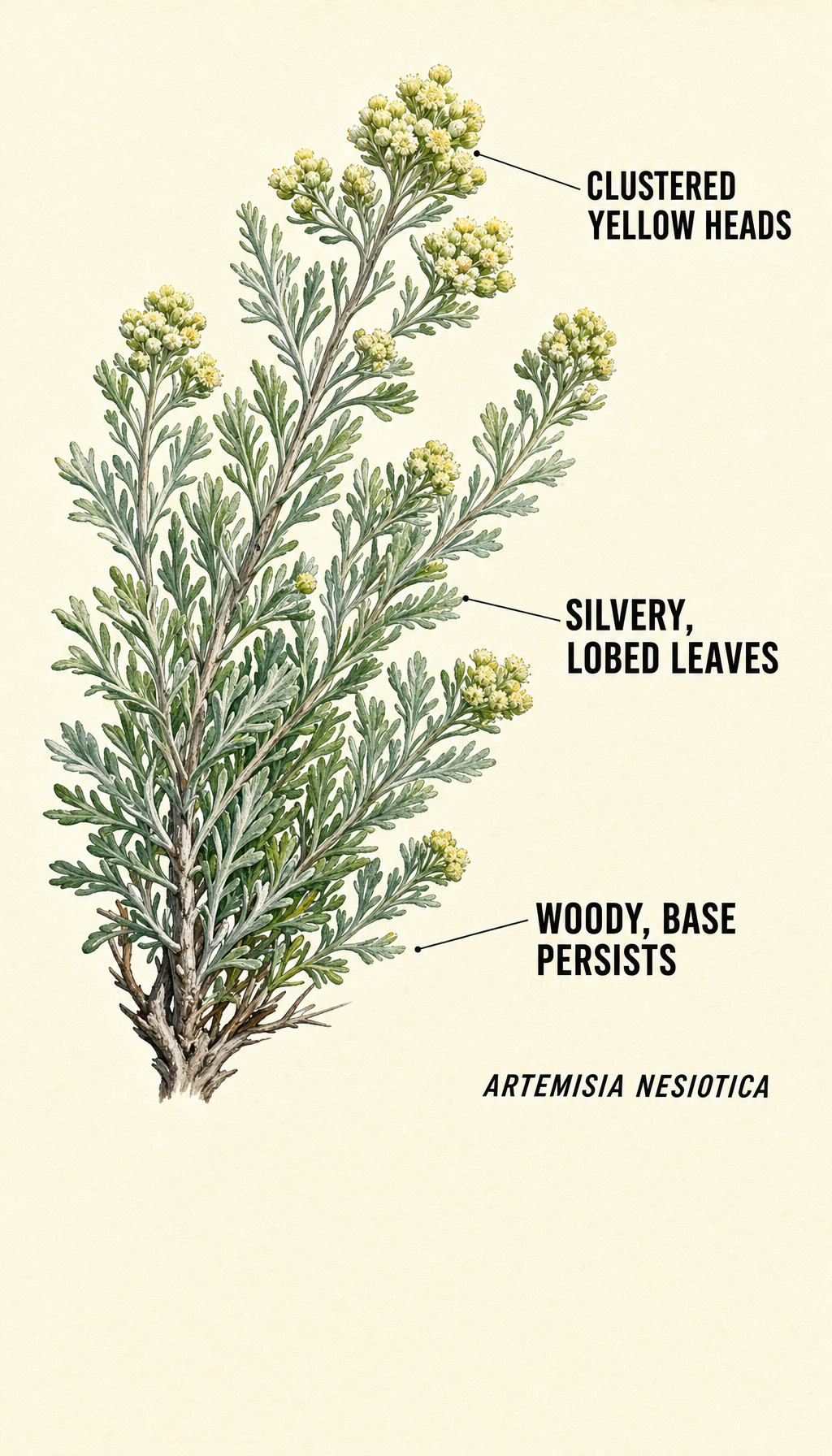
Overall form: A woody, perennial shrub or subshrub that is typically low to medium in stature and can form compact, often rounded bushes. Growth habit is generally erect to somewhat spreading.
Flower characteristics: Flowers are borne in small, inconspicuous heads (capitula) typical of Artemisia, generally lacking showy ray florets. Flower heads tend to be small and greenish to pale yellow or cream in appearance and may be clustered along stems when in bloom.
Leaves: Foliage is typically aromatic, gray-green to silvery, and often finely divided or lobed, giving a feathery or dissected appearance. Leaves are arranged alternately along the stems and may be somewhat woolly or glandular-pubescent, contributing to a muted, silvery foliage texture.
Distinctive features: Aromatic, silvery foliage with finely divided leaves and small, non-showy flower heads are diagnostic at a glance. The combination of a coastal, drought-tolerant habit and the characteristic Artemisia scent helps distinguish it from other shrubs.
Seasonal variation: Foliage color remains muted year-round in maritime climates; flowering is seasonal and produces clusters of small heads that are most noticeable on close inspection.
Habitat & Distribution
Typical ecosystems: Often found in coastal scrub, rocky bluffs, maritime chaparral and other dry, exposed island habitats with strong ocean influence.
Growing conditions: Typically occurs in well-drained, often rocky soils; adapted to full sun and low to moderate moisture. Shows drought tolerance and is commonly associated with other coastal-adapted shrub species.
Geographic distribution: Native to California and largely restricted to offshore island habitats (Channel Islands area), where it occupies a limited island range rather than widespread mainland populations.
Ecological Role
Pollinators and wildlife: Flowers are small and may attract small bees, flies, and other insects that visit inconspicuous Asteraceae heads; the aromatic foliage can deter some herbivores while still providing cover or forage to certain insects and small animals. Island populations can be ecologically important components of scrub communities.
Niche: Functions as a drought-tolerant shrub in coastal island plant assemblages, contributing to habitat structure and coastal scrub diversity.
Conservation & Interesting Facts
Because it is largely restricted to island habitats, island sagebrush is often of conservation interest due to its limited range and sensitivity to habitat disturbance.
Fascinating traits: silvery, finely divided leaves and aromatic resins are adaptive features that reduce water loss, reflect intense sunlight, and provide herbivore deterrence in exposed coastal environments.