sweet sagewort
Artemisia annua
BloomEDU
Identify it today. Know it next time.
Add sweet sagewort to BloomEDU and a short quiz tomorrow will check if the name stuck.
Get BloomEDU — add sweet sagewortFree · iOS · Android
From Instagram
Identity & Classification
Artemisia annua L. — family Asteraceae (the daisy/sunflower family). Common names include sweet sagewort, sweet wormwood, sweet annie, annual mugwort, and annual wormwood. Taxonomic notes: Artemisia is a large genus with many species that share similar common names; A. annua is the annual member in this group and is distinct from perennial Artemisia species such as A. absinthium (common wormwood) or A. vulgaris (mugwort).
Physical Description
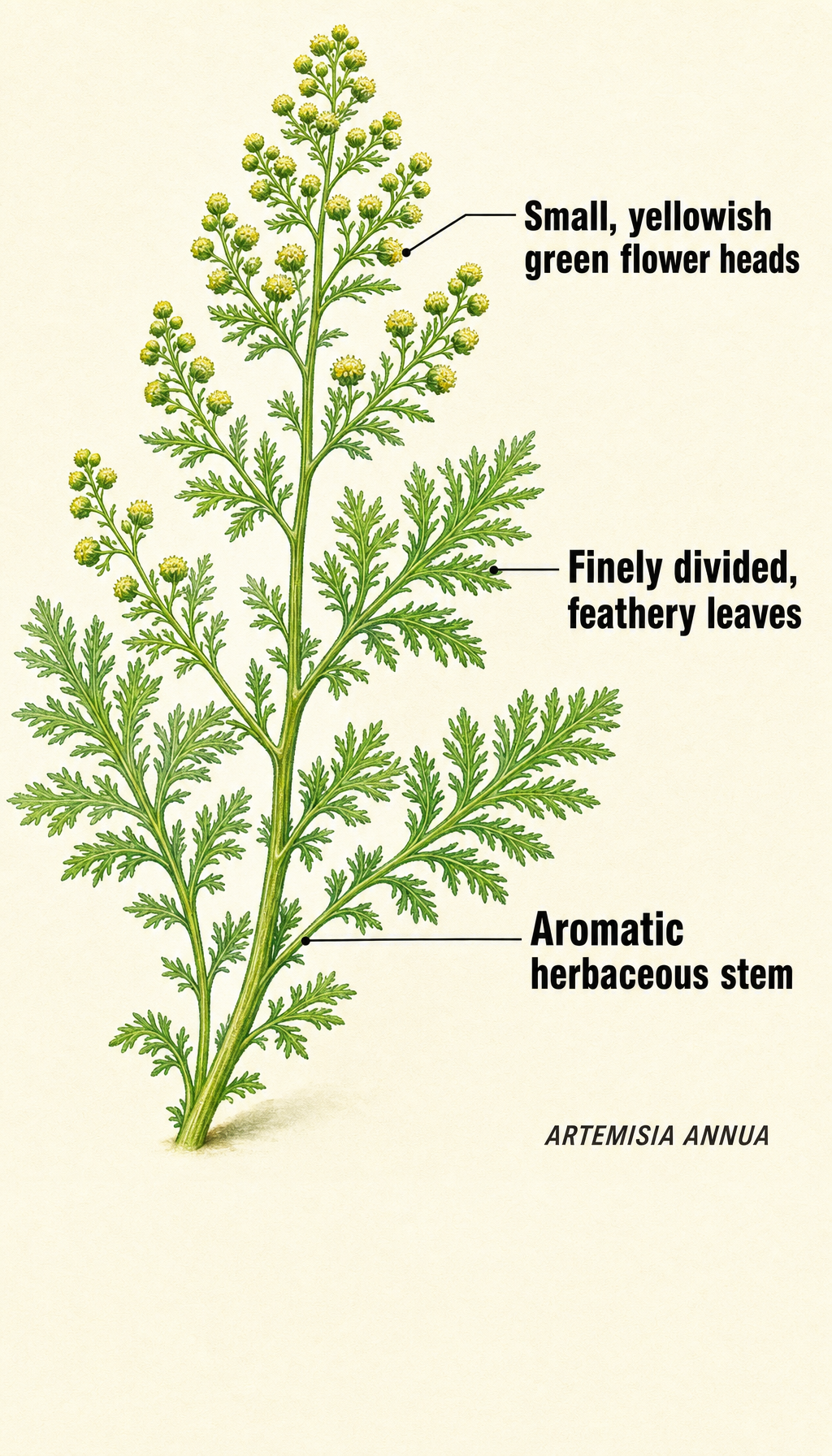
A. annua is an aromatic annual herb with a few key ID features—perfect for the plant nerd who appreciates the small things that matter.
Habit: erect, branching annual herb; typically reaches about 1–2 m (3–6+ ft) tall in favorable conditions.
Leaves: alternate, finely divided (pinnate to bipinnate), giving a lacy, soft-textured appearance; pale green to gray-green and aromatic when crushed. Leaves often have glandular trichomes (tiny oil-bearing hairs).
Stems: upright, branching, sometimes sparsely hairy.
Inflorescence & flowers: loose, open panicles of many small flower heads (capitula) with tiny tubular florets; flowers are generally yellowish to greenish. Flowering is typically in late summer to autumn.
Fruit/seed: small achenes (single-seeded fruits), produced in quantity; the plant readily sets seed as an annual.
Other distinguishing notes: the foliage’s scent and the plant’s finely dissected leaves help separate it from many other weedy or ornamental species.
Habitat & Range
Native region: temperate Asia.
Naturalization: A. annua has become naturalized in many parts of the world, including scattered occurrences in North America.
Typical habitats and preferences: often found in sunny, open, disturbed places such as fields, roadsides, waste ground and other well-drained sites; it typically favors full sun and tolerates relatively poor soils.
Note on specifics: precise country-by-country distribution and fine-scale habitat limits vary and are not exhaustively catalogued here.
Ecological Role
Pioneer/colonizer: as an annual that produces many seeds, A. annua often behaves like a colonizer of disturbed sites, contributing to early successional plant communities.
Chemical ecology: the plant produces glandular trichomes that contain a suite of secondary compounds (notably artemisinin). These compounds are biologically active in laboratory and medical contexts; their detailed effects on herbivores, microbes, and other plants in natural ecosystems are complex and not fully documented.
Pollination and wildlife interactions: flowers are small and produced in large numbers; A. annua may be visited by a variety of insects, but specific, well-documented pollinator dependencies or specialized relationships are not well-established in the literature.
Interesting Facts
Nobel plant: a humble annual whose chemistry led to breakthroughs rewarded by major scientific prizes — that’s a dramatic résumé for a roadside herb.
Where the magic hides: artemisinin is concentrated in glandular trichomes (tiny oil glands) on leaves and flowers, not uniformly distributed through the plant.
Annual vs. perennial: many Artemisia species are perennial and woody or shrubby; A. annua stands out in the genus as an annual, which helps explain its weedy, fast-growing nature.
Naturalizer: because it produces lots of small seeds and tolerates open, disturbed habitats, A. annua readily self-seeds and can naturalize outside its native range.
Name trivia: the “sweet” in many common names (sweet wormwood, sweet annie) contrasts its scent and (perceived) flavor profile with the more bitter, perennial wormwoods — hence the comparative adjective.
Open question for curious minds: while we know a great deal about artemisinin’s pharmacology, many ecological details—such as exact pollinator networks, long-term impacts of its naturalization in various regions, and the ecological role of its full suite of chemical compounds—remain areas of active study. annua in a garden setting.