dill daisy
Argyranthemum Webb
BloomEDU
Identify it today. Know it next time.
Add dill daisy to BloomEDU and a short quiz tomorrow will check if the name stuck.
Get BloomEDU — add dill daisyFree · iOS · Android
Identity & Classification
Scientific name: Argyranthemum (genus authority Webb & Berthelot); plants in this genus are often treated as Argyranthemum spp.
Verified common names: marguerite, Canary daisy; the name "dill daisy" is used in some horticultural contexts for certain cultivars or informal plantings
Family: Asteraceae (tribe Anthemideae)
Taxonomic note: Argyranthemum is a member of the daisy/chamomile tribe (Anthemideae) and is closely allied with other ornamental daisy genera.
Visual Description
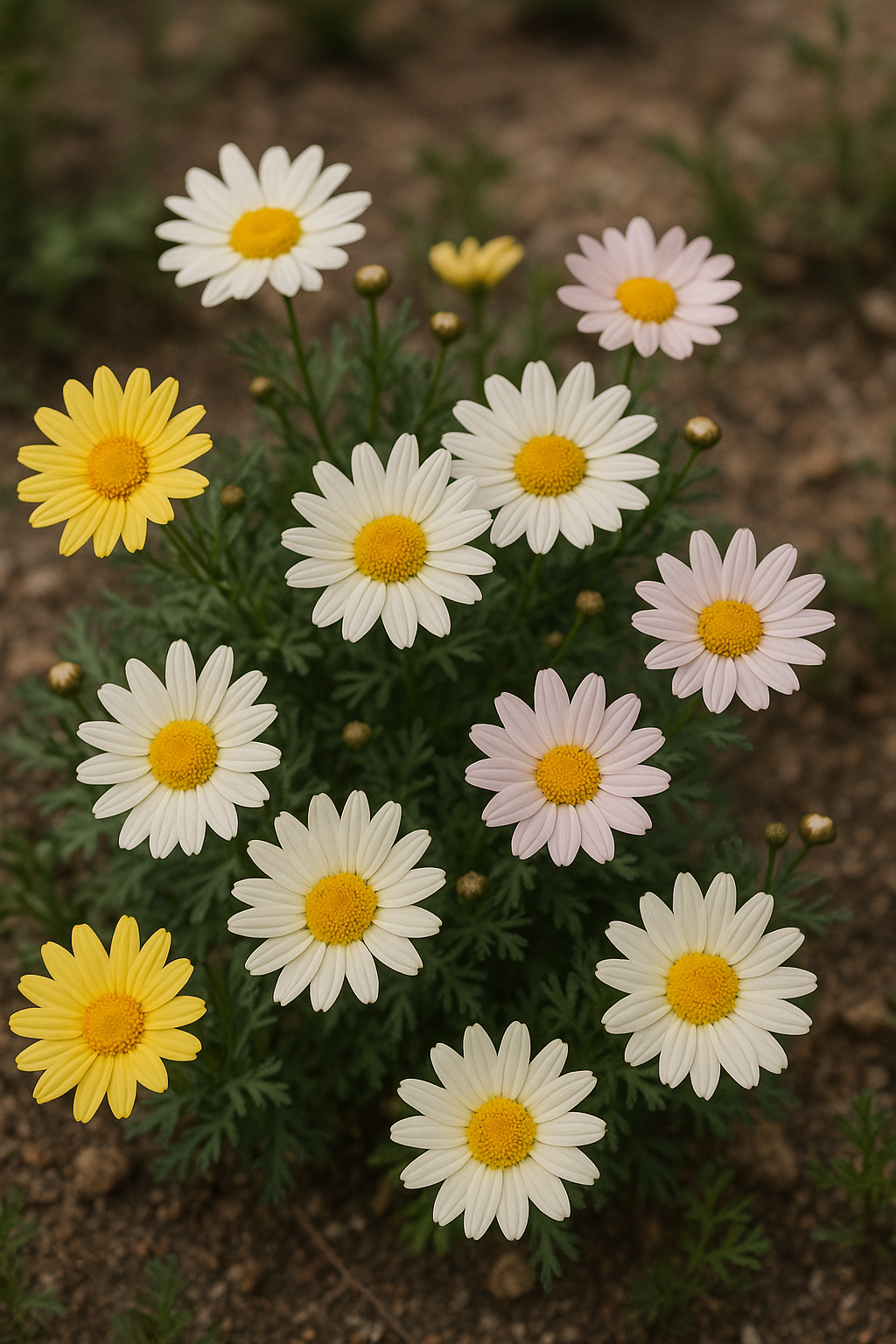
Overall form: Argyranthemum are generally bushy, evergreen or semi-evergreen subshrubs or perennial forbs with a compact, rounded habit. In cultivation they typically form low to medium-height mounds.
Flowers: Flower heads are classic daisy-type capitula with a central cluster of yellow disc florets surrounded by one or more series of white to pale pink ray florets. Ray florets are strap-shaped and may be single or double in cultivar forms; individual heads are borne singly or in loose clusters at stem tips.
Leaves: Leaves are usually alternate and pinnately divided or lobed, often with fine segments giving a feathery to toothed appearance. Foliage can be green to gray-green and may be slightly aromatic when crushed.
Distinctive features: Fine, divided foliage combined with regular daisy-like flower heads and a shrubby, branching habit distinguish Argyranthemum from many other garden daisies. Cultivated varieties often show doubled flower forms, varied ray colors, and compact growth.
Seasonal variation: In mild climates these plants often bloom from spring through fall; flowering may be reduced by heavy frost or extreme heat. Foliage persistence is greater where winters are mild.
Habitat & Distribution
Growing conditions: Typically grown in full sun to light afternoon shade, preferring well-drained soils and moderate moisture. Many types tolerate coastal exposure, reflected in their popularity in Mediterranean-climate gardens.
Ecosystems: Often found in cultivated beds, containers, and sometimes naturalized in coastal or disturbed sites where climate is suitable.
Geographic distribution: Native to the Macaronesian region (notably the Canary Islands) but commonly cultivated in California and other Mediterranean-climate regions; in California the genus is often encountered as an ornamental and may be locally naturalized in coastal areas.
Ecological Role
Pollinators: Flower heads are generally visited by a range of generalist pollinators, including bees and butterflies, attracted to the nectar and pollen.
Wildlife interactions: As showy nectar sources, these plants contribute to urban and garden pollinator resources; specific wildlife relationships vary by region and local species.
Human Uses & Cultural Significance
Primary use: Widely grown as an ornamental for borders, containers, and mass plantings; many garden cultivars have been selected for flower form and compact habit.
Traditional/medicinal uses: No well-documented traditional medicinal uses are broadly cited for the genus in mainstream botanical literature.
Conservation & Interesting Facts
Conservation: Many Argyranthemum species are native endemics of Macaronesia; conservation status depends on the specific species and local populations. Cultivated garden forms are widely available and not threatened.
Interesting fact: The genus name Argyranthemum combines Greek roots meaning "silver" and "flower," referring to the often bright, pale appearance of the blooms. Garden selections derived mainly from species native to the Canary Islands have produced a diverse range of marguerite-type daisies popular in California gardens.
From Instagram