blue-eyed African daisy
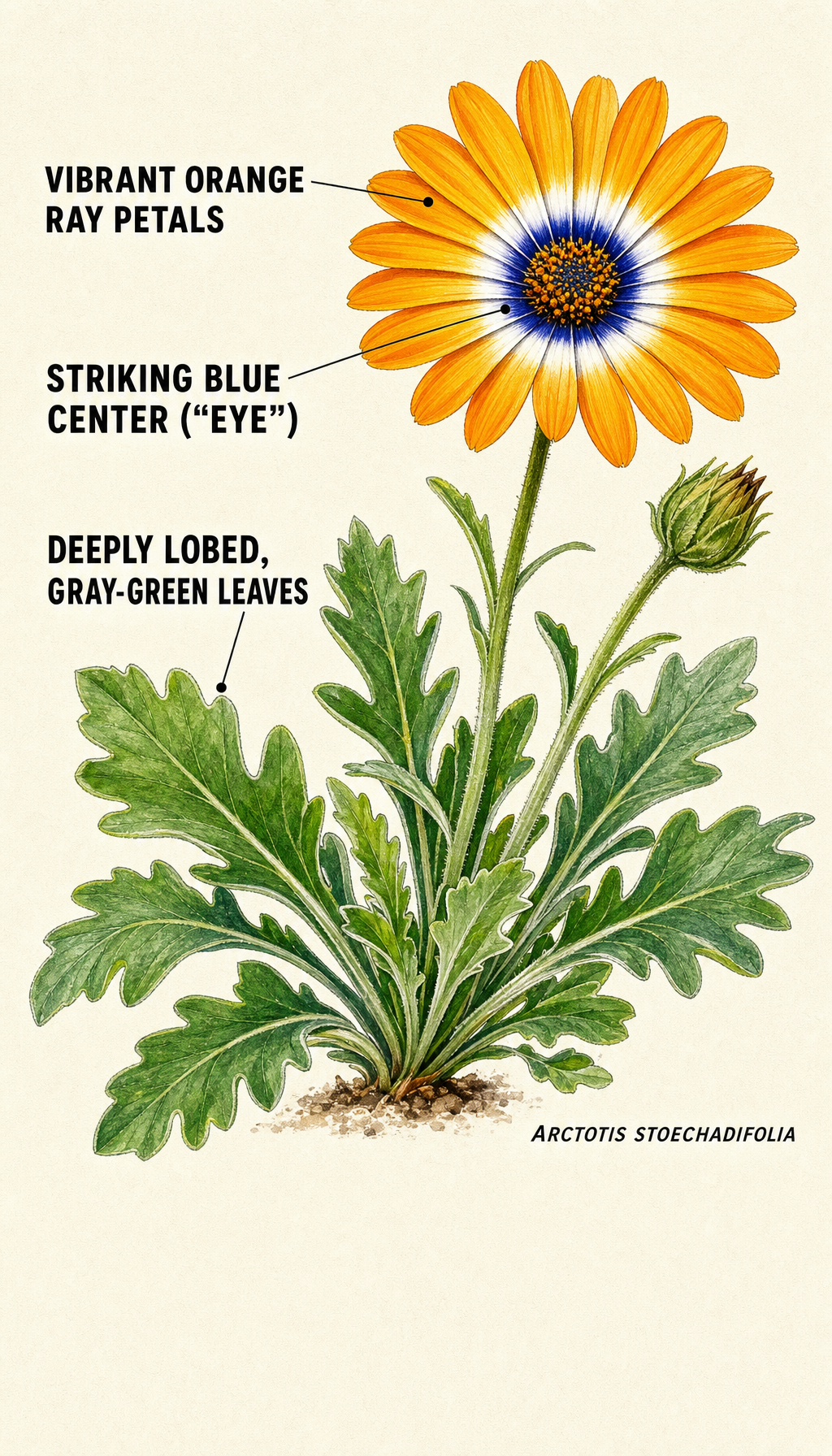
Arctotis stoechadifolia
BloomEDU
Identify it today. Know it next time.
Add blue-eyed African daisy to BloomEDU and a short quiz tomorrow will check if the name stuck.
Get BloomEDU — add blue-eyed African daisyFree · iOS · Android
Identity & Classification
Scientific name: Arctotis stoechadifolia
Verified common names: blue-eyed African daisy (common name usage may vary)
Family: Asteraceae
Genus: Arctotis
Taxonomic relationships: Member of the Arctotis genus, a group of South African daisies; taxonomic placement in Asteraceae is well established.
Visual Description
Overall form and size: A low-growing perennial to short subshrub that typically forms mounded clumps; overall height is generally modest, from ground-hugging to under a meter tall depending on growing conditions. Habit can be spreading and somewhat mat-forming in favorable sites.
Flower characteristics: Composite flower heads typical of Asteraceae, with a ring of showy ray florets surrounding a central disc of tubular florets. Ray colors are often bright—commonly orange, yellow or white—with a contrasting central “eye” that may appear darker or bluish, which gives the common name. Flower heads open in strong sunlight and often close in dull weather.
Leaf structure and arrangement: Leaves are usually lance-shaped to oblong, often gray-green and coated with fine hairs or a silky/woolly indumentum; leaves may form a basal rosette with additional alternate leaves along short stems.
Distinctive identifying features: Silvery or gray-green hairy foliage combined with daisy-like flower heads that present a conspicuous contrasting central eye. Habit of opening flowers in bright sun is characteristic of many Arctotis species.
Seasonal variation: Flowering is often most conspicuous in warm, sunny seasons (commonly spring into summer in many climates), with plants reducing aboveground growth in less favorable conditions; individual flowers tend to open on sunny days.
Habitat & Distribution
General growing conditions and ecosystems: Typically found in open, sunny sites such as coastal slopes, sandier or well-drained soils, and disturbed or rocky ground in its introduced range. Tolerant of dry, exposed conditions and often used in sunny, drought-prone plantings.
Moisture, light, and soil preferences: Prefers full sun and well-drained soils; often drought-tolerant once established and not suited to persistently wet or waterlogged soils.
Geographic distribution: Native to southern Africa (regionally concentrated in the Cape area). In the United States it has been recorded in CA, MA, and SC, where occurrences are generally of introduced or cultivated plants rather than native populations.
Ecological Role
Pollinators: Flowers provide nectar and pollen and are attractive to a variety of insect pollinators, including bees and butterflies; the sun-responsive opening of flowers concentrates rewards during warm, sunny periods.
Wildlife interactions: Serves primarily as a nectar and pollen source for insects; notable wildlife uses beyond pollinator visitation are not broadly documented.
Ecological niche: Functions as a sun-loving, drought-adapted flowering groundcover or short-lived perennial in open coastal and dry habitats.
Human Uses & Cultural Significance
Ornamental: Widely cultivated for ornamental use in gardens, coastal plantings, and drought-tolerant landscapes for its showy blooms and silvery foliage.
Toxicity: No widely reported toxic effects in standard horticultural literature.
Conservation & Interesting Facts
Many Arctotis species have dense leaf hairs that reduce water loss and reflect intense sunlight—an adaptation to dry, exposed habitats. Flowers of African daisies often open only in bright sun, creating dramatic displays that recede on cloudy days.
From Instagram