shagbark manzanita
Arctostaphylos rudis
BloomEDU
Identify it today. Know it next time.
Add shagbark manzanita to BloomEDU and a short quiz tomorrow will check if the name stuck.
Get BloomEDU — add shagbark manzanitaFree · iOS · Android
From Instagram
Identity & Classification
Scientific name: Arctostaphylos rudis
Verified common name: shagbark manzanita
Family: Ericaceae
Genus: Arctostaphylos
Taxonomic note: a member of the manzanita group (Arctostaphylos), related to other evergreen, urn-flowered shrubs in Ericaceae.
Visual Description
Overall form: an evergreen shrub that is typically compact to mounding or narrowly erect; plants commonly form dense, woody stems with a shrub habit.
Size: typically grows to shrub size (from low, spreading forms to multi-stemmed upright shrubs), often occupying low to mid-canopy positions in shrublands.
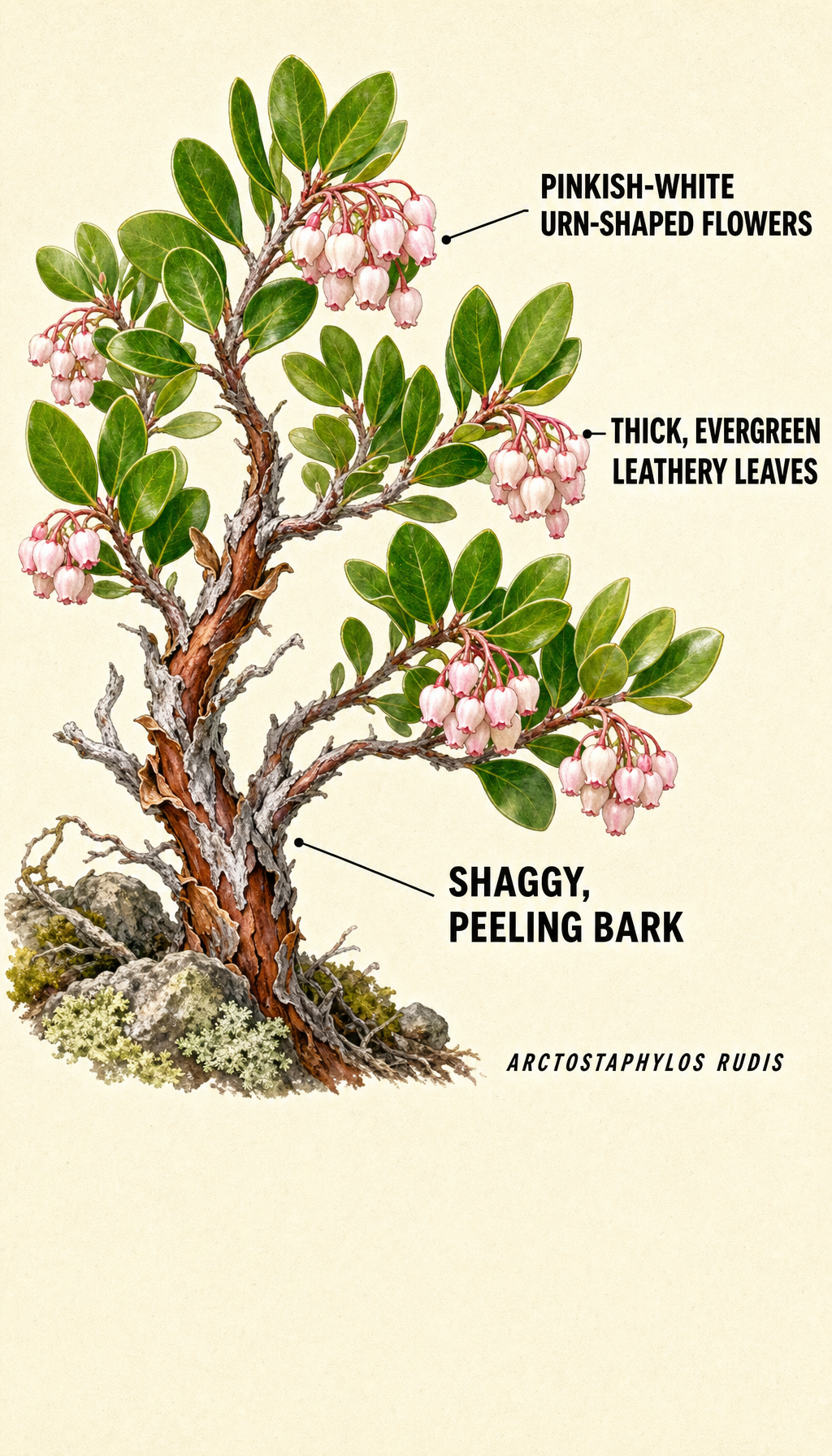
Flowers: borne in clusters, the flowers are urn-shaped (urceolate), usually white to pinkish; corollas are fused and generally present the typical Ericaceae form with a small opening at the tip (often in the 4–6-lobed range).
Leaves: simple, alternate, evergreen leaves that are generally leathery and glossy to dull green; shapes range from elliptic to obovate with entire margins and a smooth surface when mature.
Fruit and seeds: produces small, rounded drupes typical of manzanitas; fruits are often reddish to brownish when mature and contain several nutlets.
Distinctive features: characteristically shredding or peeling bark that gives the common name “shagbark,” combined with the urn-shaped flowers and evergreen leathery leaves; young twigs may be smooth and reddish on many manzanitas.
Seasonal variation: leaves remain year-round; flowering often occurs in the cooler seasons in many Arctostaphylos species (commonly late winter into spring), followed by fruiting later in the season.
Habitat & Distribution
General growing conditions: typically found in dry, well-drained sites such as chaparral, coastal scrub, rocky slopes, and other shrubland ecosystems where Mediterranean-climate conditions prevail.
Moisture, light, soil: often occurs in sunny to partly shaded exposures and on soils that are well-drained and often rocky or poor in fertility; adapted to seasonal drought typical of California landscapes.
Geographic distribution: known from California; occurrence is within the state’s native shrubland regions.
Ecological Role
Pollinators: flowers of Arctostaphylos species are well-suited to bee pollination; native bees, including bumblebees and other solitary bees, are common visitors.
Wildlife interactions: fruits provide a food resource for birds and mammals, and the dense shrub form offers cover and nesting habitat for wildlife.
Ecological niche: contributes to shrubland structure and biodiversity in Mediterranean-climate communities, often as a long-lived evergreen component.
Conservation & Interesting Facts
Etymology: the genus name Arctostaphylos means “bear grapes” in Greek; the common name manzanita means “little apple” in Spanish.
Unique adaptations: evergreen leathery leaves and urn-shaped flowers are adaptations to dry Mediterranean climates and promote efficient water use and specialized pollination.