threecorner leek
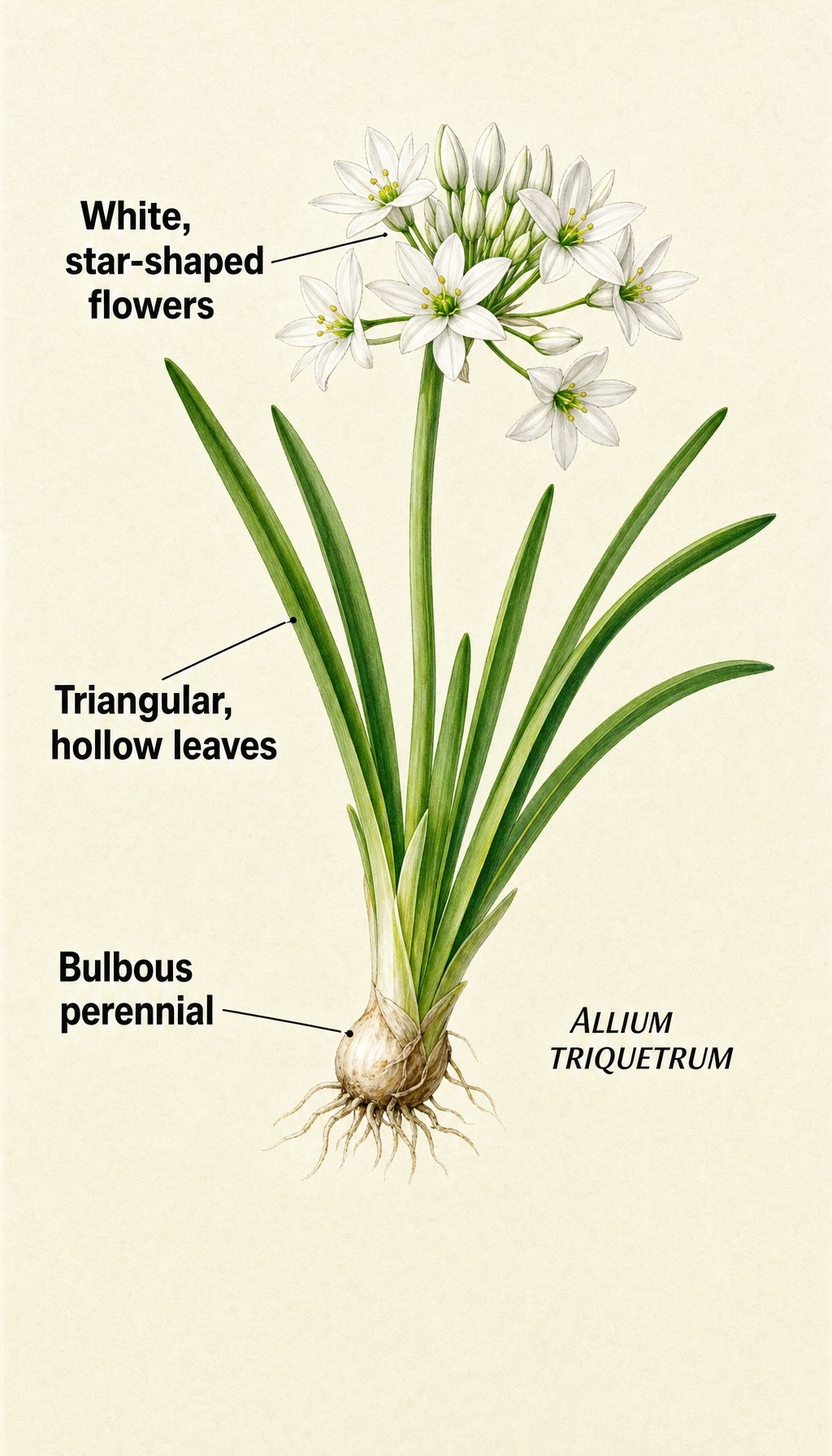
Allium triquetrum
BloomEDU
Identify it today. Know it next time.
Add threecorner leek to BloomEDU and a short quiz tomorrow will check if the name stuck.
Get BloomEDU — add threecorner leekFree · iOS · Android
From Instagram
Identity & Classification
Scientific name: Allium triquetrum
Verified common names: three-cornered leek, three-cornered garlic
Family: Liliaceae (historical placement); many modern treatments place Allium in Amaryllidaceae, subfamily Allioideae
Genus: Allium
Visual Description
A bulbous perennial with a clumping habit, three-cornered leek typically forms low patches of foliage and flowering scapes. Plants often produce one to a few erect, triangular (three-angled) flowering stalks arising from small bulbs. Flowers are borne in loose, nodding umbels of several bell-shaped blooms; each flower typically has six white tepals with a distinctive green midrib and may appear pendent. Leaves are usually basal, straplike and smooth, often appearing as a pair or a few leaves per bulb; they are generally flat rather than hollow and emit a mild onion/garlic scent when crushed. Distinctive features include the three-angled flower stalk (hence “three-cornered”), the nodding white bells with green midribs, and the onion-like aroma. Seasonal variation: in mild Mediterranean-type climates the plant commonly flowers from late winter into spring, with leaves present through the flowering period and senescing afterward.
Habitat & Distribution
Three-cornered leek typically grows in shaded to semi-shaded sites with moderate moisture. It is often found in gardens, woodlands, riparian corridors, hedgerows and other disturbed or semi-natural habitats where soils are reasonably fertile and not excessively dry. The species is commonly naturalized in parts of California and Oregon and is originally native to the western Mediterranean region. It tolerates a range of soil types but is often associated with damp, well-drained soils and sheltered microsites.
Ecological Role
Flowers provide accessible pollen and nectar to a variety of generalist pollinators, including bees and other insects that visit small, bell-shaped Allium flowers. The bulbs and leaves produce sulfurous compounds that give an onion/garlic odor; this chemistry contributes to interactions with herbivores and microbes and may reduce grazing by some mammals.
Conservation & Interesting Facts
Allium triquetrum is not generally considered threatened in its native range but is regarded as an invasive or weedy naturalized species in parts of California and Oregon where it can form dense carpets and displace native groundcover. A notable adaptation is its three-angled scape, a reliable field character that gives the species its common name and aids identification.