horse chestnut
Aesculus hippocastanum
BloomEDU
Identify it today. Know it next time.
BloomEDU can suggest a name from a plant photo, and later ask if you still know it.
Get BloomEDUiOS · Android
From Instagram
Do you know horse chestnut?
Three questions from BloomEDU's question library for this plant. Pick an answer, or open Show the answer, to see why.
What distinctive leaf feature helps identify horse chestnut in the field?
Show the answer
Answer: Large palmately compound leaves with 5–7 leaflets radiating from a single point
Why: Look for leaves like an open hand: five to seven large leaflets all radiate from one central point, giving the tree a bold, fan-like outline.
The flowers of horse chestnut are typically:
Show the answer
Answer: Showy upright terminal panicles of white to pink-tinged tubular/bell-shaped flowers with a central blotch
Why: Its flowers stand upright in showy clusters, usually white with a pink flush and a colored blotch near the center that helps guide pollinators.
During which season does horse chestnut put on its conspicuous floral display?
Show the answer
Answer: Spring, before full canopy closure
Why: The tree makes its main floral show in spring, often before the dense canopy has fully closed around the flowers.
Identity & Classification
Scientific name: Aesculus hippocastanum L.
Verified common names: horse chestnut, conker tree
Family: often placed in Sapindaceae (historically treated in Hippocastanaceae)
Genus: Aesculus
Visual Description
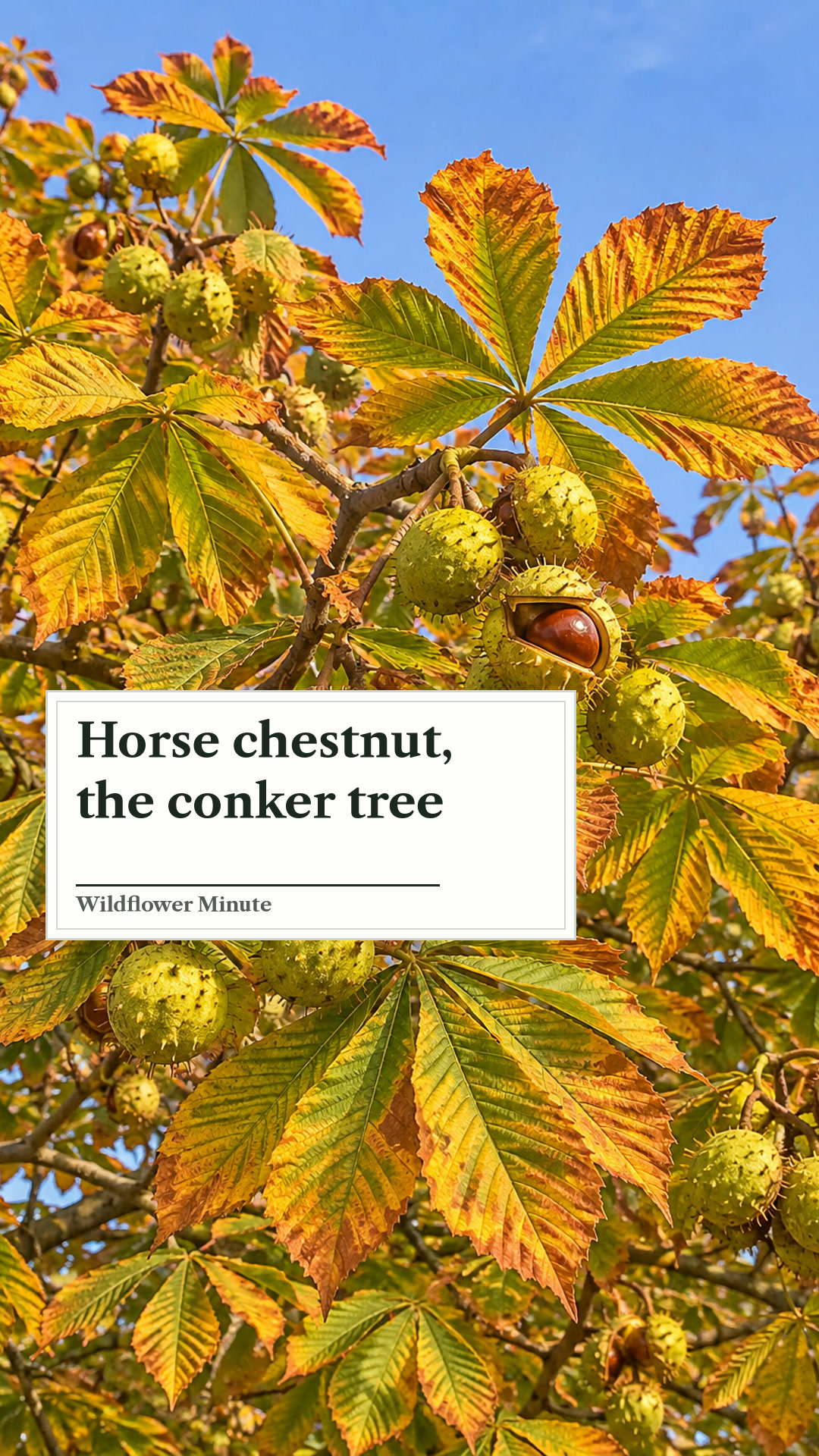
Horse chestnut is a deciduous, medium-to-large shade tree, typically reaching canopy heights in the range of about 12–25 m in cultivation. It has a broadly rounded crown and stout branches. Flowers appear in upright, terminal panicles that are showy and often white to pink-tinged with a central yellow, pink or red blotch; individual flowers are tubular to bell-shaped with multiple petal-like lobes (commonly 4–6, often 5). Leaves are palmately compound with leaflets radiating from a single point — usually 5–7 leaflets (often 7) — borne oppositely along the twigs; leaflets are elliptic to obovate with serrated margins. Distinctive identifying features include the large palmately compound leaves, terminal corymb-like clusters of conspicuous flowers in spring, sticky terminal buds, and the spiny green capsules that split in autumn to reveal one or a few glossy brown, spherical seeds known as conkers. Seasonal variation: spring brings prominent floral displays, summer shows lush compound foliage, and autumn produces the conspicuous seed capsules as leaves turn and drop.
Habitat & Distribution
Horse chestnut is commonly planted in parks, avenues and large gardens and is often found in urban and cultivated landscapes across temperate regions. It typically prefers moist, well-drained soils and grows best in full sun to partial shade. It is tolerant of a range of soils but is often planted where moisture is reliably available. In the United States it is recorded in many states including CT, GA, IA, IL, IN and 17 more, reflecting widespread cultivation rather than a native range (native to southeastern Europe).
Ecological Role
Flowers produce abundant nectar and pollen and are attractive to bees (including bumblebees) and other pollinating insects, particularly in spring when few other large floral displays are available. The heavy, glossy seeds are not a major food source for most wildlife because they contain toxic compounds; some animals may still interact with fallen seeds or use the capsules for cover.
Conservation & Interesting Facts
Noted cultural fact: the glossy brown seeds are called conkers and are central to the traditional children’s game “conkers” in parts of Europe. An adaptive feature is the species’ conspicuous, nectar-rich spring inflorescences that attract pollinators early in the season, helping ensure pollination before full canopy closure in mixed plantings.